A cross-jurisdictional corruption case is rarely resolved by a single investigator working alone. Funds moving through multiple accounts, companies operating across borders, and electronic evidence stored overseas often require cooperation between several law enforcement agencies.
This reality has encouraged discussion about joint investigation in Indonesia. While the concept appears straightforward, its implementation raises important legal questions because investigative authority is divided among the Corruption Eradication Commission (KPK), the Attorney General’s Office, and the Indonesian National Police. Understanding how these institutions coordinate, supervise, and exercise their respective powers is essential for businesses, legal practitioners, and foreign investors operating in Indonesia.
Understanding Joint Investigation Within Indonesia’s Anti Corruption Framework
Joint investigation, as the term has developed internationally, refers to an arrangement in which two or more law enforcement authorities, whether within one country or across borders, conduct a single investigation together, with defined division of labor, evidence sharing, and integrated decision making. This differs from informal inter agency cooperation because joint investigation is typically anchored by a formal agreement setting out the scope of authority, responsibilities, and joint accountability.
It is worth distinguishing joint investigation from several mechanisms that are often conflated with it. Coordination between agencies is looser. Each authority continues to run its own investigation while exchanging information. Supervision, as practiced within the Indonesian system, places one institution, the Corruption Eradication Commission, in a position to oversee an investigation conducted by another agency without merging the investigative process itself. Parallel investigation occurs when two agencies pursue related but separate matters arising from the same set of facts, such as a corruption investigation running alongside a related money laundering inquiry.
One point deserves particular emphasis. Indonesian legislation does not yet recognize joint investigation as a formal regime in the sense practiced in certain other jurisdictions. The Criminal Procedure Code and the anti corruption statutes provide for coordination and supervision, not a structurally integrated joint investigative process. Consequently, when the term joint investigation korupsi appears in Indonesian public discourse, it is more accurately understood as functional inter agency cooperation carried out within each institution’s existing legal authority, rather than as a distinct legal category.
Indonesia’s Legal Framework Governing Corruption Investigations
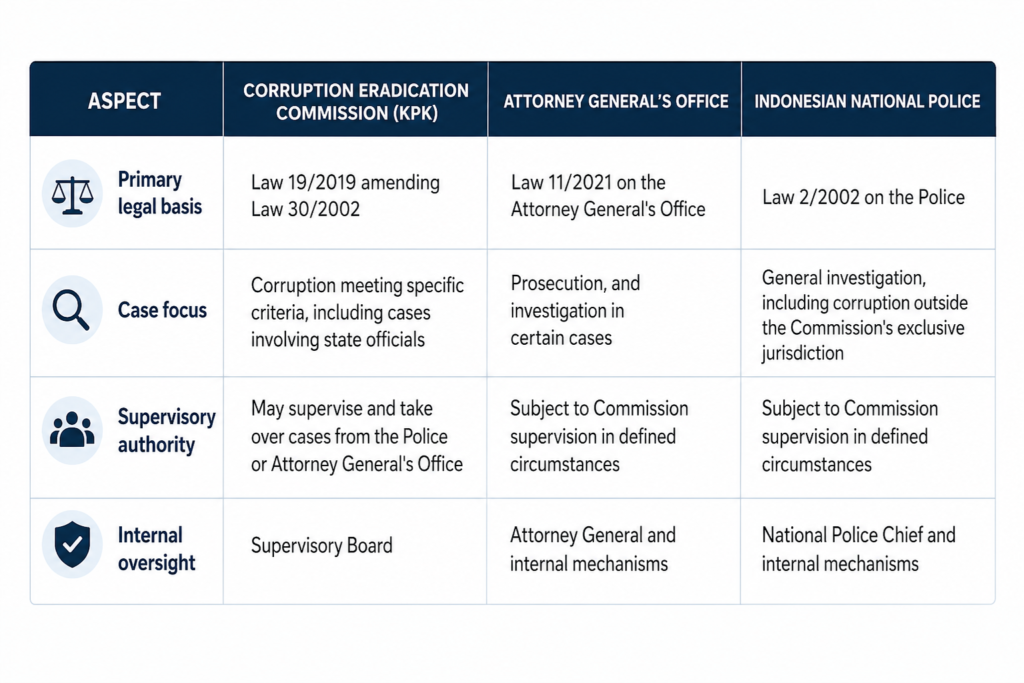
Indonesia’s legal framework for handling corruption cases rests on several complementary layers of regulation. The Criminal Procedure Code provides the general reference for criminal investigations, including corruption, insofar as matters are not specifically governed by more specialized legislation. Law Number 31 of 1999 as amended by Law Number 20 of 2001 concerning the Eradication of Corruption forms both the substantive and procedural foundation for corruption enforcement, including the allocation of investigative authority among the Police, the Attorney General’s Office, and the Corruption Eradication Commission.
Law Number 19 of 2019, the second amendment to the Corruption Eradication Commission Law, introduced important institutional adjustments, including the establishment of a Supervisory Board that now shapes how the Commission coordinates with other law enforcement bodies. Law Number 11 of 2021 concerning the Attorney General’s Office strengthened that institution’s position as both prosecutor and, in certain cases, investigator, while Law Number 2 of 2002 concerning the Indonesian National Police remains the basis for the Police’s general investigative authority, including corruption matters that fall outside the Commission’s exclusive jurisdiction.
These three institutions hold structurally overlapping authority to investigate corruption, a design that has always carried the seeds of institutional tension. The coordination and supervisory powers granted to the Commission were intended to manage that overlap, not eliminate it. In practice, this coordination takes shape through preliminary information exchange before formal investigations begin, joint case exposure sessions, and, in defined circumstances, the Commission’s authority to take over cases from the Police or the Attorney General’s Office.
A more delicate issue arises at the stage of evidence management and accountability for jointly made decisions. When two institutions handle different facets of the same set of facts, for instance the Commission investigating a bribery element while the Police pursue an accompanying money laundering charge, questions about which institution holds authority to store, test, and present evidence at trial become critical to legal certainty. The absence of a formally structured joint investigation mechanism means such questions are still resolved largely through inter agency memoranda of understanding and institutional goodwill rather than through an explicitly binding legal framework.
Accountability is the next issue that cannot be overlooked. The more institutions involved in a single investigative process, the more complex the lines of responsibility become when procedural errors or rights violations occur. Indonesia’s criminal justice system, in which pretrial review functions as the principal control mechanism over the legality of an investigation, needs strengthening so that it can adequately address situations where more than one institution is investigating simultaneously.
International Models Shaping Joint Corruption Investigations
The European Union has long developed Joint Investigation Teams as a formal instrument grounded in a binding legal framework among member states, allowing investigators from different jurisdictions to work within a single team with clearly defined authority to gather and use cross border evidence. The strength of this model lies in legal certainty. Every team member knows precisely the limits of their authority, how evidence will be used, and who bears responsibility for each investigative step. The comparison matters not because Indonesia should replicate the European structure verbatim, but because it illustrates that the effectiveness of joint investigative cooperation depends heavily on the clarity of its governing legal framework, not merely on institutional goodwill.
In the United States, white collar crime and corruption enforcement frequently involves several agencies at once, among them the Department of Justice, the Securities and Exchange Commission, and tax authorities, operating through multi agency task forces with explicitly defined roles from the outset of an investigation. This model shows that overlapping authority is not necessarily a weakness when balanced by clear coordination protocols and a legal culture that respects each agency’s independence. Singapore, through its Corrupt Practices Investigation Bureau, takes yet another approach, centralizing authority within a single institution working closely with the prosecution, thereby minimizing the risk of overlap from the outset.
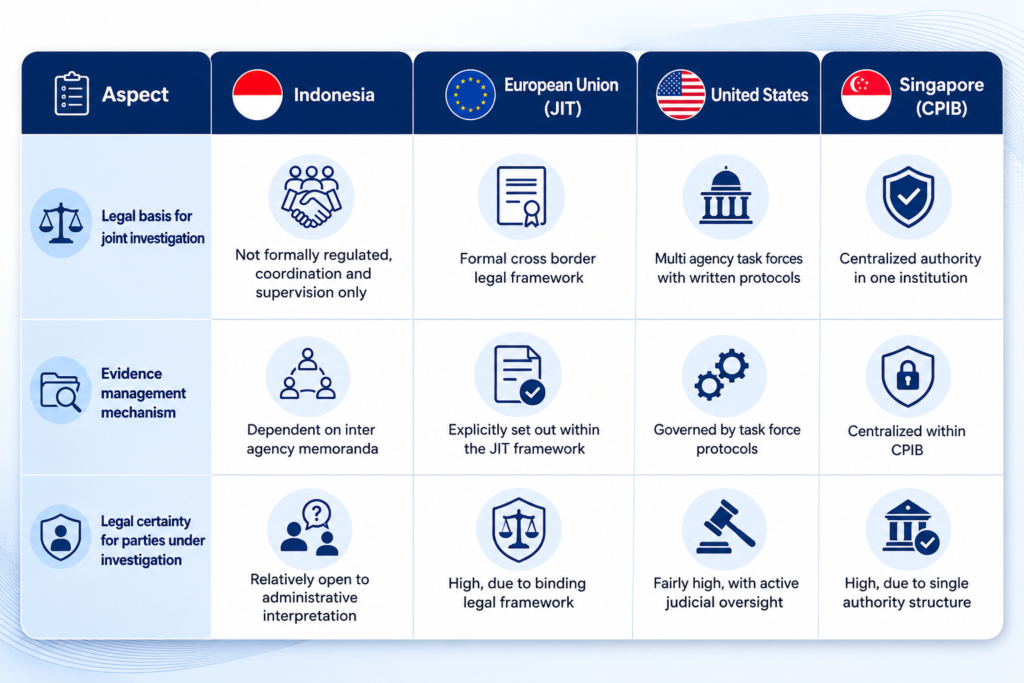
Of these three models, the most relevant lesson for Indonesia is not which institutional structure is superior, but the importance of establishing clear rules before joint investigative work begins. Strengthening the memoranda of understanding among the Commission, the Attorney General’s Office, and the Police into more detailed and binding instruments, paired with a rapid mechanism for resolving jurisdictional disputes, would provide the legal certainty that currently rests largely on administrative practice.
For business, these dynamics are far from academic. Multinational companies and foreign investors operating in Indonesia should understand that a single alleged violation can trigger investigations from more than one institution simultaneously, with document and information requests arriving from different directions within a short span of time. Directors and compliance officers should ensure document preservation protocols activate as soon as indications of an investigation emerge, including refraining from routine data deletion that could later be construed as obstruction.
An independently conducted and well documented internal investigation is an essential tool for mapping the facts before external institutions complete their own inquiries. Internal auditors and compliance teams should work closely with external legal counsel to assess legal risk realistically rather than defensively. Legal counsel’s role in this context is strategic. It bridges communication with law enforcement, safeguards the procedural rights of the company and individuals concerned, and structures litigation or negotiation strategy with the possibility that more than one institution may be involved in the same matter.
Closer institutional cooperation in handling corruption cases undoubtedly strengthens enforcement effectiveness. That benefit, however, endures only when matched by legal certainty, procedural transparency, institutional accountability, and protection of fundamental rights for those under investigation.