Surat Edaran Mahkamah Agung Nomor 4 Tahun 2026 (“SEMA 4/2026”) sets out six circumstances in which an appeal or cassation application against a criminal judgment in Indonesia will not reach a higher court for examination. It also confirms that an acquittal cannot be appealed or taken to cassation at all. For companies and individuals facing criminal proceedings, the circular functions as a procedural map, not a new theory of liability.
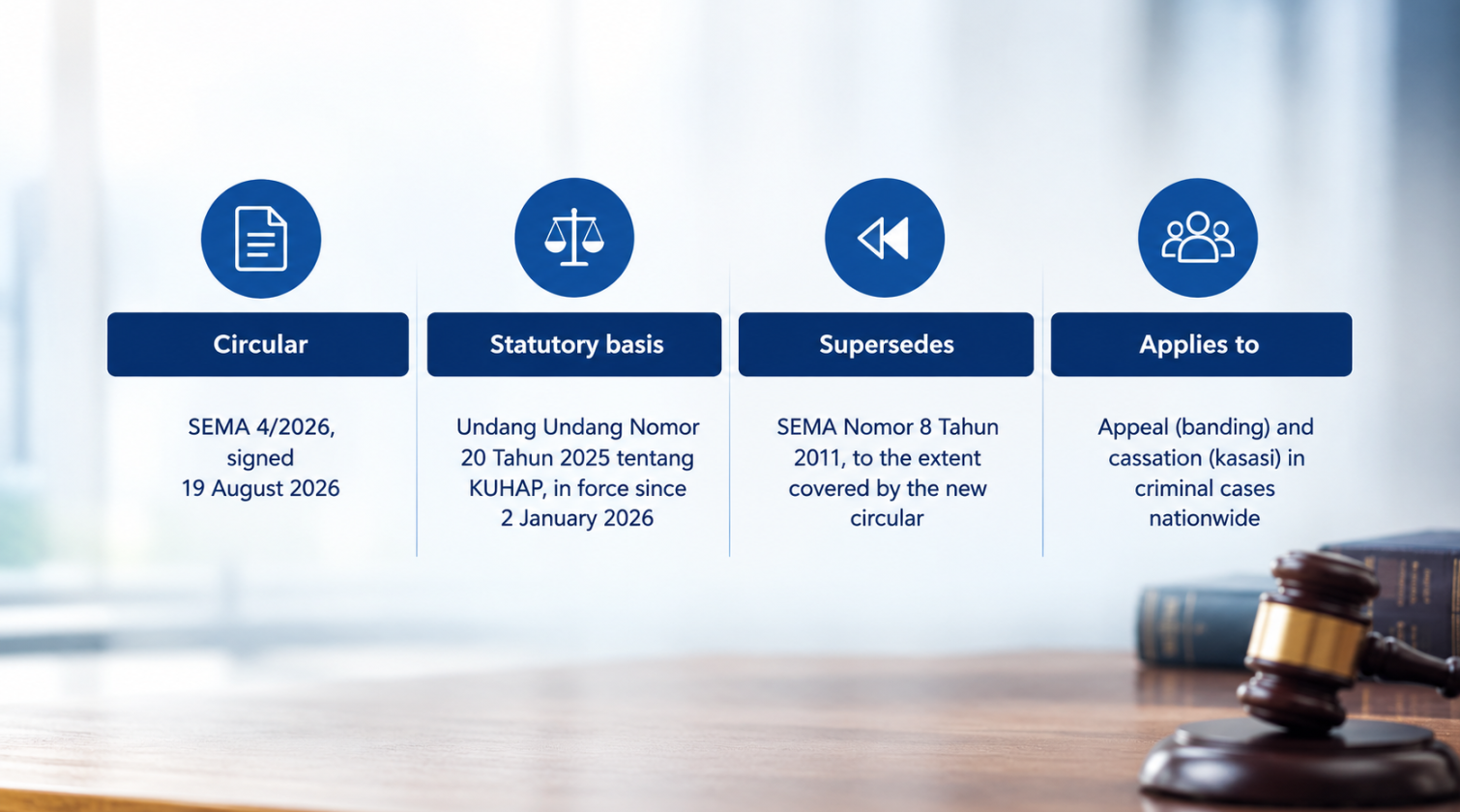
A criminal case does not end because a party believes an appeal or cassation application remains open. Under the framework the Supreme Court set out in SEMA 4/2026, whether a remedy exists in law, and whether the filing itself meets the applicable formal requirements, decides whether a higher court examines the case at all.
The change is procedural, not substantive. SEMA 4/2026 instructs judges and court registrars on how to treat appeals and cassation applications that are legally barred or formally defective, without altering who can be prosecuted or on what grounds.
What SEMA 4/2026 changes in practice
The circular treats an acquittal (putusan bebas) differently from a release judgment (putusan lepas), issued when the court finds the act proven but not punishable as a crime. Against an acquittal, neither appeal nor cassation is available under any circumstance. The Supreme Court grounds the cassation bar in Article 299 paragraph (2) letter a of KUHAP and the appeal bar in Article 26 paragraph (2) of Law Number 48 of 2009 on Judicial Power.
A release judgment sits on different footing. Appeal against it remains legally possible, and SEMA 4/2026 governs what follows once that happens. The defendant must be released from detention the moment the verdict is read, and if the prosecutor appeals, authority over further detention shifts to the appellate court rather than staying with the court of first instance. The circular also annexes a standard verdict format that first instance courts must follow when handing down a release judgment, covering release from detention, rehabilitation, and the allocation of case costs.
Separately, SEMA 4/2026 addresses six circumstances in which an appeal or cassation application fails on formal grounds, regardless of the merits underneath it.
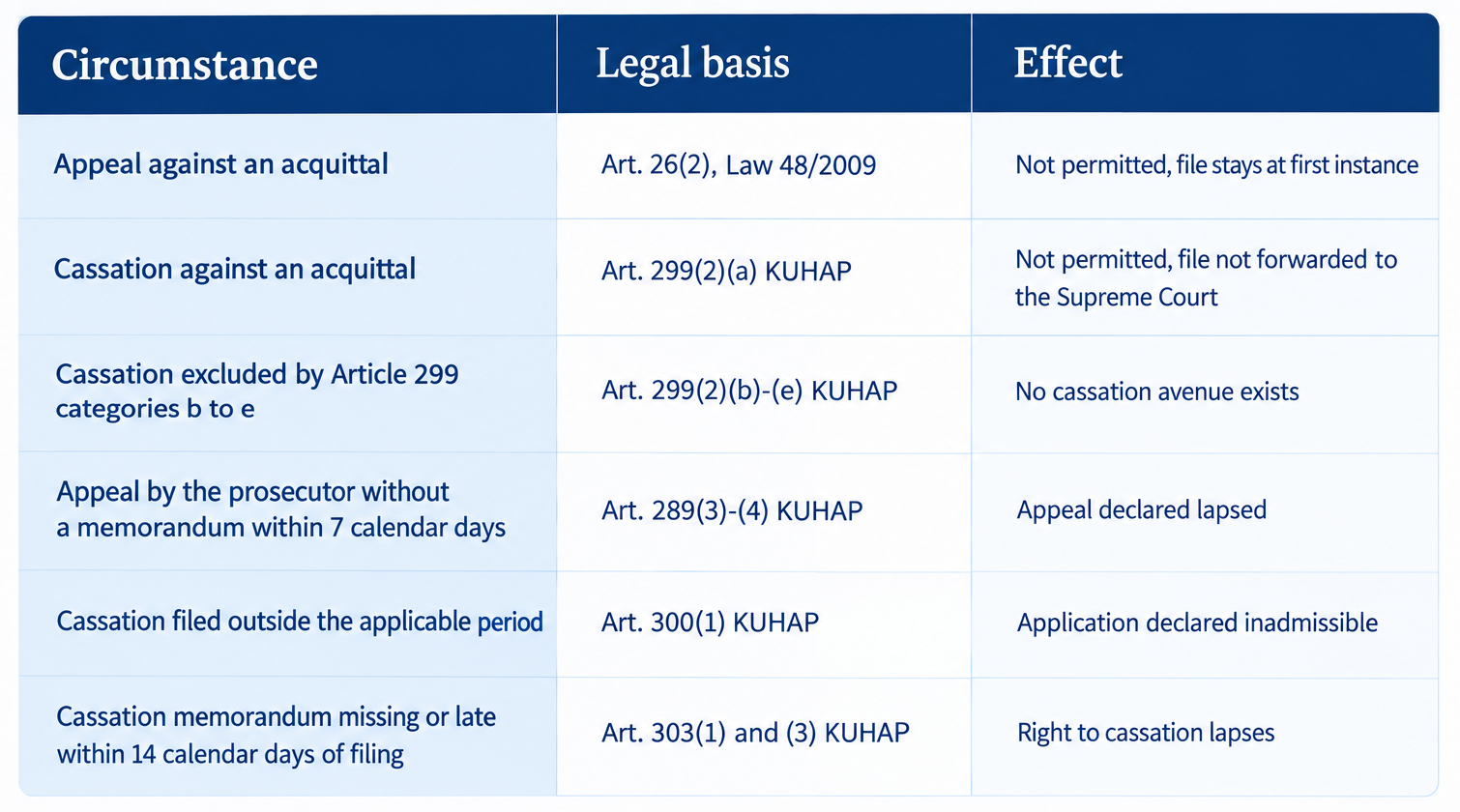
Where a filing falls into one of these six categories, the head of the district court issues a determination closing the matter at that level. No further remedy applies against that determination, whether by objection, appeal, cassation, or judicial review, and the case file does not travel further up the court system.
What companies should change in litigation strategy
The classification above carries straight into strategy. Companies, and the directors or commissioners often named alongside them in a criminal matter, gain little from waiting until a verdict is close before asking whether an appeal or cassation is available. Whether the judgment is an acquittal, a conviction, or a release judgment decides the available pathway before any deadline calculation begins.
What companies should watch
- Whether the judgment is an acquittal, which forecloses appeal and cassation outright
- The filing period for the chosen remedy, which SEMA 4/2026 treats as fixed rather than negotiable
- The separate memorandum deadlines, 7 calendar days for a prosecutor’s appeal and 14 calendar days for a cassation memorandum
- The detention consequences that follow a release judgment once an appeal is filed
Litigation strategy built on the assumption that every adverse procedural outcome can move to the next court invites exposure that has nothing to do with the underlying facts of the case. Coordination between external counsel and internal legal or compliance teams matters most in the days after a judgment is issued. These filing and memorandum periods run from the moment the verdict or the appellate decision is communicated, and a missed period cannot be corrected afterward.
None of this means SEMA 4/2026 requires a company to adopt a specific compliance programme. The circular is silent on that question. Its relevance for business lies in procedure, and companies should treat that procedure with the same discipline they apply to commercial deadlines.
Key takeaways
SEMA 4/2026 reads best as a procedural discipline measure rather than a new source of corporate criminal liability. It draws a sharp line around acquittals, sets out what happens to detention after a release judgment, and lists six formal defects that keep an appeal or cassation application from reaching a higher court. None of that changes who can be held criminally liable or on what substantive grounds.
For companies operating in Indonesia, the significance of the circular lies in what happens when litigation strategy gets the procedure wrong. A remedy that is unavailable, late, or formally defective ends the case at that level regardless of the merits, and the determination that closes it cannot itself be challenged. Assessing appeal and cassation pathways early, rather than close to a deadline, belongs in the broader criminal risk management that companies and their advisers carry out whenever a business or the individuals within it face criminal proceedings in Indonesia.