Corruption cases in Indonesia routinely cite a state financial loss figure attributed to BPK, BPKP, or a law enforcement audit, often without specifying which institution actually holds the authority to produce it. Under the 1945 Constitution and Law No. 15 of 2006 on the Audit Board of the Republic of Indonesia (“BPK Law”), only the Audit Board of the Republic of Indonesia (“BPK”) holds the constitutional mandate to examine state finances. The Financial and Development Supervisory Agency (“BPKP”) and law enforcement agencies, namely the Police, the Attorney General’s Office (“Kejaksaan”), and the Corruption Eradication Commission (“KPK”), operate under separate legal bases and perform different functions within a corruption case.
BPK Authority Over State Financial Loss
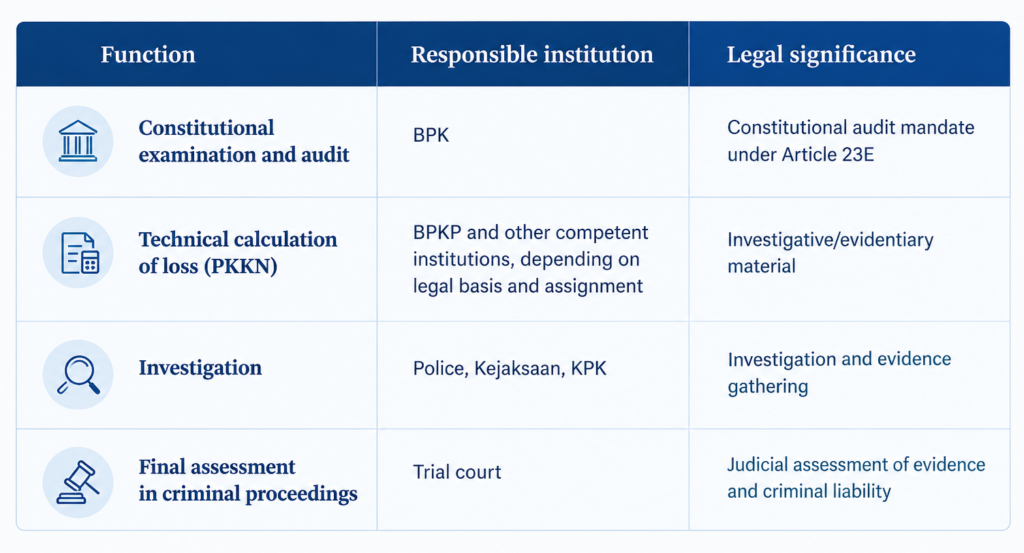
Article 23E of the 1945 Constitution gives BPK a free and independent function to examine the management and accountability of state finances. BPK’s official legal framework sets out this constitutional mandate and the principal legislation governing its audit authority. Article 6(1) of the BPK Law converts that mandate into binding audit authority, tasking BPK with examining financial management across central and regional government, other state institutions, Bank Indonesia, state and regional enterprises, and other bodies that manage state finances. BPK’s resulting Laporan Hasil Pemeriksaan carries particular legal weight because its position is constitutional rather than administrative.
What Role Does BPKP Play?
BPKP operates differently. It functions under the President as an internal government auditor, and law enforcement routinely requests its services to calculate state financial loss (“PKKN”), a technical calculation ordered during an active investigation. In its August 2026 submission to the Constitutional Court, BPKP confirmed it continues to accept these investigative and PKKN assignments from the Police, Kejaksaan, and KPK, while telling the Court that its audit findings serve as evidence for a judge to weigh, not a final determination of loss.
Law enforcement sits in a third position. The Police, Kejaksaan, and KPK do not examine state finances themselves. They investigate, gather evidence, including whatever audit findings BPK or BPKP produced, and build a case theory around whether a loss occurred and who caused it. The division of investigative authority among these institutions can itself affect how a corruption case develops.
The table below summarizes where each function sits.
Constitutional Court Case No. 206/PUU-XXIV/2026
This division of function is now being tested before the Constitutional Court. In Decision No. 28/PUU-XXIV/2026, issued in February 2026, the Court rejected a challenge to Articles 603 and 604 of Law No. 1 of 2023 on the Criminal Code and affirmed BPK’s constitutional standing to establish actual, rather than merely potential, state financial loss. Readers have since drawn sharply different conclusions from that ruling. In a separate and still pending Constitutional Court Case No. 206/PUU-XXIV/2026, a former Ministry of Defense official facing corruption charges over a satellite procurement project, based largely on a BPKP calculation, argues the Explanation of Article 603 should be read to mean BPK alone.
The institutions that appeared before the Court in the August 2026 hearings do not share that reading. The Supreme Court said the amount of state financial loss is ultimately a matter for the trial judge, and that no single audit result, including BPK’s, binds the court as sole determinant. The Police maintained that technical calculation may come from any competent institution, while the final assessment satisfying the state financial loss element should rest on BPK’s constitutional position. KPK, in the same round of hearings, pushed back against concentrating that function in one institution.
The Court ordered BPK, BPKP, the Attorney General’s Office, the Police, and KPK to coordinate directly and report their conclusions in open court, rather than settling the question by immediate ruling. As of 15 September 2026, the Constitutional Court had not issued a final decision. The Court scheduled a further hearing for 6 October 2026 to hear the outcome of the inter-agency coordination meeting.
Key Takeaways
An audit report, whether from BPK or BPKP, is not by itself a finding of criminal liability. A party contesting an allegation can still challenge the audit’s methodology before a court, and a BPKP calculation obtained during an investigation remains legally a piece of evidence rather than a concluded determination of loss.
Companies involved in a government procurement matter or public finance dispute should review any BPK or BPKP finding on its own methodological merits rather than treat it as conclusive. Executives and public officials facing a corruption allegation should assess early which of the two audit bodies produced the figure relied upon and on what legal basis. Investors evaluating litigation exposure tied to a state financial loss allegation should track the outcome of Case No. 206/PUU-XXIV/2026, since a final ruling may narrow or confirm which audit findings satisfy the loss element of a corruption charge.