Executives and counsel who face a dispute touching many people in Indonesia often ask which procedure applies. The question of citizen lawsuit vs class action in Indonesia looks like a question of scale, yet scale does not decide it. Each mechanism protects a different interest, runs on a different procedural footing and produces different relief. A claim filed under the wrong label can end at a preliminary stage, before any court reviews the merits.
Interests, Standing and Procedure
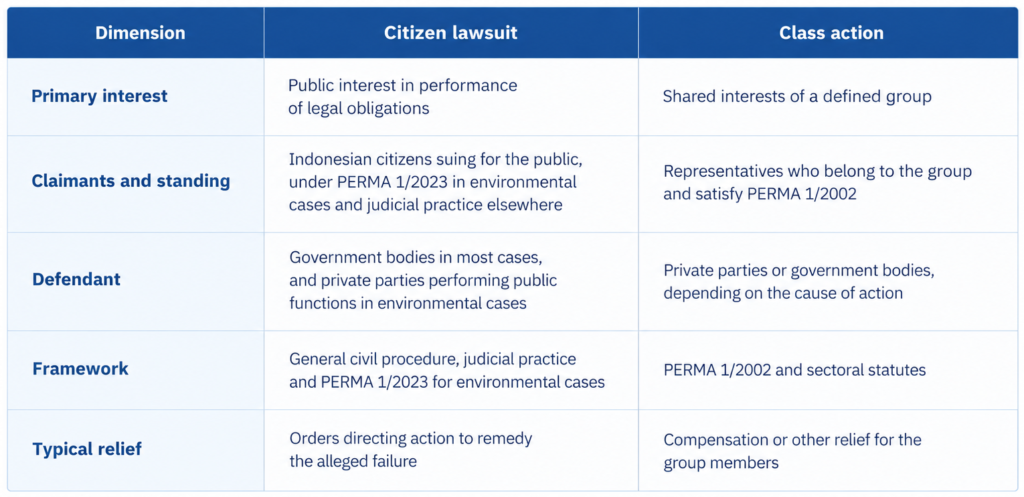
A citizen lawsuit protects the public interest. Indonesian citizens sue on behalf of the public and allege that a government authority, or in some cases a private party, failed to perform a legal obligation. They ask the court to order action and do not claim compensation for a private loss. Under PERMA 1/2023, plaintiffs must serve written notification on the prospective defendant 60 days before filing, a step that class actions do not require.
Indonesian civil procedure has no general regulation for this mechanism, which developed through judicial practice. PERMA 1/2023 now defines and regulates citizen lawsuits in environmental cases, in both the state administrative courts and the district courts. In the district courts, Article 35 limits the relief to orders that the defendant perform legal duties concerning the making of regulations. Outside that field, courts apply general civil procedure and their own precedent, so standing and remedies are harder to predict.
A class action is representative litigation. One or more members of a group sue for themselves and for the other members, who have suffered loss from common facts. PERMA 1/2002 on Class Representative Actions remains the principal procedural reference, and PERMA 1/2023 still points to it for environmental claims.
Article 2 calls for a group too large for efficient individual suits, common facts or events, a common legal basis of substance, the same type of claim and a representative with the honesty and sincerity to protect the group. The judge reviews these conditions at the outset and can stop the case if the procedure does not fit. When the court grants damages, it specifies the amount owed and the persons or subgroups entitled to it.
A valid class action requires notice to the group and a period in which members may opt out. Sectoral statutes recognise the mechanism, including Article 46(1)(b) of the Consumer Protection Law (Law 8 of 1999) and Article 91 of the Environmental Protection and Management Law (Law 32 of 2009).
Choosing The Mechanism in Practice
Take a hypothetical. Residents of a river basin allege that a regional government has ignored its legal duty to control industrial discharge. They want the authority to act and none seeks damages. A citizen lawsuit in the administrative court fits, because the claim concerns a public duty and the relief directs the authority. A class action is a weak fit, since no group compensation is sought.
Now take a second hypothetical. Thousands of consumers buy the same defective product from one company and each suffers a similar financial loss. The facts, legal basis and type of claim are common, and separate suits would burden the courts. A class action under PERMA 1/2002 and the Consumer Protection Law fits. A citizen lawsuit does not, because the consumers want compensation for their own losses and no order on a public duty.
Numbers and public salience settle nothing. Five hundred residents who seek damages from a factory are class action candidates even though pollution is a public issue. A group that wants a ministry to adopt a regulation does not gain class action status because many people would benefit. The defendant does not settle the question either, since PERMA 1/2023 allows class actions in the state administrative courts, where the defendant is a government body.
Counsel should test three points covering the injured party, the defendant and the relief the court can grant. Public authorities, and the companies that hold permits from them, can face citizen lawsuits that seek enforcement action or permit revocation.
The nature of the claim decides the mechanism. A claim that a public duty went unperformed points to a citizen lawsuit. A claim for the shared losses of an identifiable group points to a class action. Citizen lawsuits outside environmental cases still rest on judicial practice, so counsel should confirm current legislation and recent decisions before filing.