A company can wake up with a different person running the business even when the name on its register of shareholders has not moved. The shift can happen through an offshore holding vehicle changing hands, a family transferring a controlling stake in a parent entity two or three layers above the Indonesian operating company, or a private equity fund exiting in favor of a new sponsor. In each scenario, the entity recorded as the immediate shareholder may stay the same while the party who decides who sits on the board and what that board does has changed. Indonesian company law and OJK regulation increasingly treat this shift in control as distinct from a direct transfer of shares.
Legal control is not always identical to holding shares directly in the entity being controlled. It can run through a chain of holding companies, through voting arrangements, or through the practical ability to determine who sits on the board and what policies that board adopts. Indonesian regulators have built distinct vocabulary around this distinction, and it differs depending on whether the entity sits inside the financial services sector or qualifies as a Public Company under capital market rules.
Shareholder, Controlling Shareholder, and Ultimate Controller Are Different Concepts
For financial services entities, Otoritas Jasa Keuangan (“OJK”) Regulation No. 30 of 2024 on Financial Conglomerates and Financial Holding Companies (“POJK 30/2024“) separates two concepts.
For a Public Company, OJK Regulation No. 45 of 2024 on Development and Strengthening of Issuers and Public Companies (“POJK 45/2024“) applies a separate test. A controller is a party that directly or indirectly owns more than 50% of the voting shares that have been fully paid up, or that has the ability to determine, directly or indirectly and by any means, the management and policies of the company. The second limb matters as much as the first. A party holding well under half the shares can still qualify as controller if it can shape who runs the company and how.
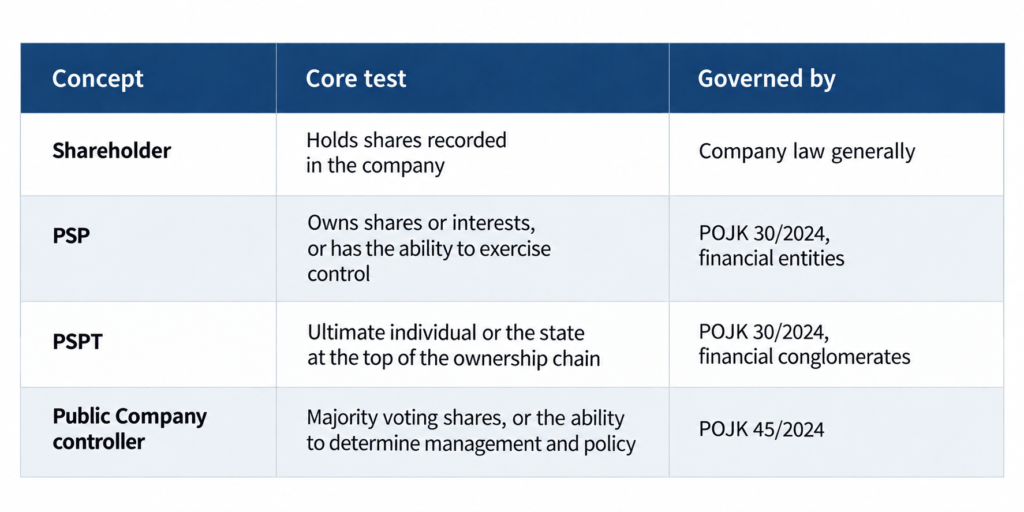
None of these terms apply uniformly across every Indonesian company, and PSPT in particular remains a financial sector concept. It does not serve as a general label for whoever ultimately owns any Indonesian business.
When the Controller Changes, the Company Needs to Look Beyond the Share Register
A new controller shapes a company’s decision making in ways a simple share transfer at the operating level cannot. The controller nominates directors and commissioners, sets the direction management pursues, shapes corporate policy, and steers how shareholders vote at general meetings. Where the company sits in a regulated sector, the controller also carries the regulatory and disclosure responsibilities that attach to the company itself.
POJK 45/2024 requires a Public Company to determine its controller, report that determination to OJK, and repeat the exercise whenever the controller changes. OJK also retains authority in certain circumstances to designate a party as controller regardless of how that party is otherwise described. A change of controller does not automatically trigger disclosure as a material fact. The company must weigh the event against whatever material information requirements already apply to it.
The change of controller can also raise the separate question of whether it amounts to a takeover under the Public Company takeover regime. An internal restructuring several layers above the operating company is not the same as an acquisition of shares that shifts control of the Public Company itself. Where the latter occurs, OJK Regulation No. 9/POJK.04/2018 on Takeovers of Public Companies can trigger a mandatory tender offer obligation for the incoming controller. That obligation applies only within a defined regulatory trigger. It does not follow automatically from every change somewhere in a corporate chain.
For an ordinary private company outside a regulated sector, OJK reporting obligations do not automatically apply. The consequences depend on what the company’s own documents say. Articles of association, shareholder agreements, financing covenants, licence conditions, and any change of control clause in a commercial contract will determine whether a shift in ultimate control triggers a consent right, an event of default, or nothing at all.