
When Can Government Decisions Be Challenged?

A government decision can hit a business through a suspended licence, a sanction, or a withdrawn entitlement. An unfavourable decision alone does not make it unlawful. Two questions frame the analysis. Does the decision or action fall within the scope of administrative judicial review? Can the challenger establish a legally recognised defect? Law No. 30 […]
State Financial Loss Authority Faces New Constitutional Court Test

Corruption cases in Indonesia routinely cite a state financial loss figure attributed to BPK, BPKP, or a law enforcement audit, often without specifying which institution actually holds the authority to produce it. Under the 1945 Constitution and Law No. 15 of 2006 on the Audit Board of the Republic of Indonesia (“BPK Law”), only the […]
SEMA 4/2026 and Criminal Litigation in Indonesia

Surat Edaran Mahkamah Agung Nomor 4 Tahun 2026 (“SEMA 4/2026”) sets out six circumstances in which an appeal or cassation application against a criminal judgment in Indonesia will not reach a higher court for examination. It also confirms that an acquittal cannot be appealed or taken to cassation at all. For companies and individuals facing […]
Indonesia’s 2026 Outsourcing Rules and What Employers Need to Review

Minister of Manpower Regulation No. 7 of 2026 on Outsourced Work (“Permenaker 7/2026”), took effect on 30 April 2026, the day the Minister signed it. Companies operating in Indonesia have until 30 April 2028 to bring the type and scope of their outsourcing arrangements into line. The regulation narrows lawful outsourcing to six categories of […]
How to Obtain an NIB for Your Business in Indonesia

Business owners in Indonesia, whether launching a new company or formalising an existing operation, will encounter a requirement to obtain a Nomor Induk Berusaha (“NIB”), or Business Identification Number, early in the process. Issued through the Online Single Submission (“OSS”) system, the NIB functions as the official business identification instrument within Indonesia’s risk based business […]
South Korea’s New Shareholder Rights Test

On 27 August 2026, the Financial Times reported that Flashlight Capital Partners, a Singapore based activist investor, offered approximately KRW906.6 billion, equivalent to roughly US$655 million, to acquire a combined 20.6 percent stake in S1 Corporation from five Samsung affiliates, Samsung SDI, Samsung Life Insurance, Samsung Fire and Marine Insurance, Samsung Securities and Samsung Card. […]
Bank Account Freeze Indonesia: The Legal Limits on Restricting a Citizen’s Account During a Protest
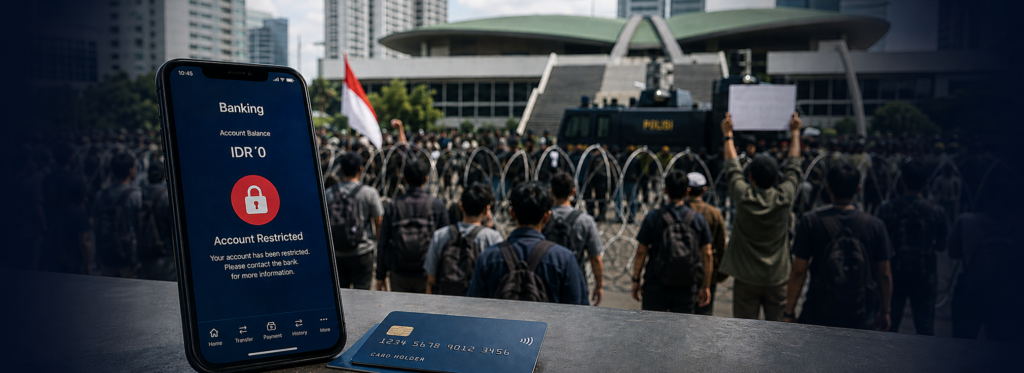
A citizen’s bank account was suspended this week around the time of a protest outside the House of Representatives, reviving a familiar Indonesian pattern. Funds collected for protest logistics sat frozen after the bank restricted access to the account. Police and the bank called it a temporary transaction delay. Indonesian law treats that differently from […]
Forest Fires, Natural Disasters and Environmental Damage in Indonesia and the Limits of Government Regulatory Responsibility

Forest fires in Bromo and Rinjani national parks, a magnitude 7.7 earthquake in Flores, recurring haze across Kalimantan and long-standing illegal logging concerns in Papua have placed a single question back on the table for corporate clients and investors operating in Indonesia. Does government responsibility begin only after a disaster strikes, or does the law […]
Hajj Payment Dispute and Cross Border Risks

On 19 August 2026, Indonesia’s Deputy Minister of Hajj and Umrah, Dahnil Anzar Simanjuntak, told the House of Representatives that Saudi authorities had blocked roughly 14 million Saudi riyals, about Rp66.6 billion, from Indonesia’s advance payment for the 2027 Hajj season. Saudi authorities tied the block to alleged insurance violations connected to the 2026 Hajj, […]
Multi Track Litigation: When One Business Mistake Creates Multiple Legal Risks

A company discovers that an operational failure in a product, service, or business decision has triggered a customer complaint. At first the problem looks manageable. The customer service team handles it, management treats it as minor, and everyone assumes it will be resolved within weeks. Then the picture changes. The consumer complaint becomes a police […]