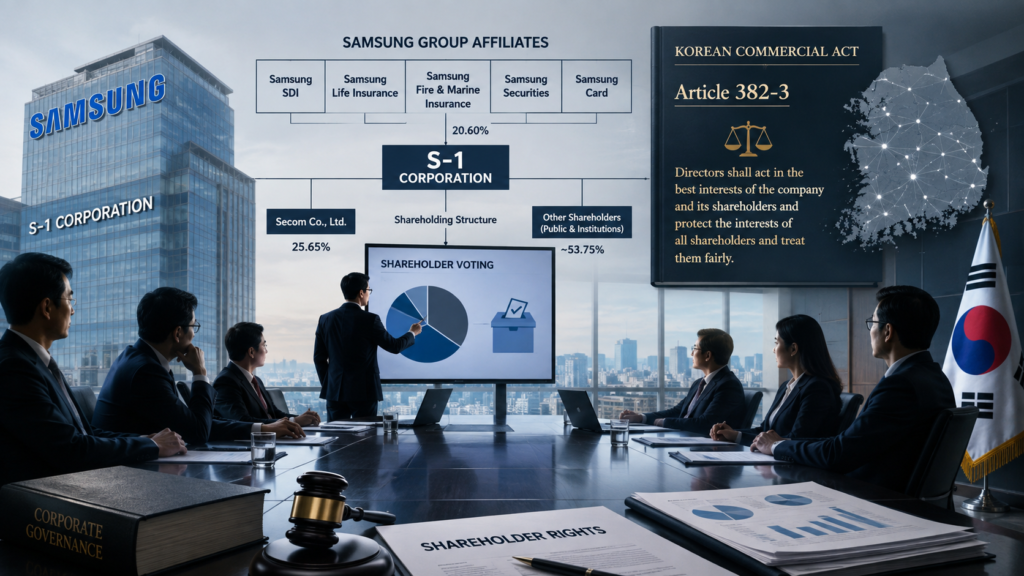
On 27 August 2026, the Financial Times reported that Flashlight Capital Partners, a Singapore based activist investor, offered approximately KRW906.6 billion, equivalent to roughly US$655 million, to acquire a combined 20.6 percent stake in S1 Corporation from five Samsung affiliates, Samsung SDI, Samsung Life Insurance, Samsung Fire and Marine Insurance, Samsung Securities and Samsung Card. S1 is South Korea’s largest security services provider and a Samsung Group affiliate. The offer sits well above the company’s previous record share price, and it hands the five affiliates’ boards a decision with implications far beyond one security company.
Flashlight has spent months criticising S1’s valuation, board composition, management expertise, disclosure practices and use of corporate capital. S1 rejects the suggestion that its governance is deficient and points to its independent directors, dividend policy and management credentials. Secom, the Japanese security company, remains S1’s largest single shareholder with approximately 25.65 percent. The five Samsung affiliates now have until 23 September 2026 to respond. The transaction tests a narrower question than who wins this one deal. It tests whether South Korea’s revised Commercial Act can move shareholder rights from a formal entitlement written into statute toward real influence over how a chaebol linked company is governed.
South Korea’s Commercial Act Expands Directors’ Duties to Shareholders
Until July 2025, Article 382-3 of the Commercial Act required directors to perform their duties in good faith for the interest of “the company.” Korean courts read that word narrowly, as the corporate entity itself, which in practice often meant the controlling shareholder sitting above it. Lawmakers rewrote that duty through an amendment effective 22 July 2025. Directors must now act faithfully for the company and its shareholders, and they must protect the interests of shareholders as a whole and treat all shareholders fairly. A board can no longer point to what benefits the company as an abstraction, or what benefits the controlling shareholder, and treat that as sufficient justification without accounting for the effect on minority holders.
The amendment changes what reasoning a board must show to reach a decision. Before, a director defending a decision that favoured a controlling shareholder could lean on the company’s interest as sufficient justification. Now that defence has to survive a separate fairness test applied to shareholders as a whole. Independent directors evaluating transactions involving controlling shareholders or activist investors must also consider the revised shareholder-protection standard. The duty governs how a board reasons about a decision. It does not decide who wins a contest for corporate control.
Why Stronger Shareholder Rights Do Not Mean More Corporate Control
A stronger duty of loyalty does not automatically give shareholders more votes or board seats. This distinction is also important in understanding how General Meetings of Shareholders operate and how shareholder voting rights are exercised. Treating the two as the same risks overreading what the amendment does. Directors at the five Samsung affiliates can still decline Flashlight’s offer, provided they conclude that retaining the S1 stake serves the company and its shareholders better than selling at a premium. The revised Article 382-3 changes what reasoning a board must show for that conclusion. It does not remove the board’s discretion to reach it.
The same caution applies to Flashlight. An activist investor pressing for board changes, better disclosure or a stake sale tests whether existing governance holds up to scrutiny. That does not make Flashlight’s proposal aligned with the interests of shareholders as a whole. Flashlight owns a minority position in all five Samsung affiliates and stands to profit from the terms it proposed. Testing governance and representing shareholder interests are related but distinct roles, and a board evaluating the offer under its fairness duty has to weigh both.
The S-1 Battle Tests Korea’s New Corporate Governance Rules
S1’s defence rests on its independent directors, dividend policy and management credentials. Under the new standard, the board must show it treated all shareholders fairly. Following formal governance procedures is no longer enough on its own. Secom’s 25.65 percent holding and the dispersed ownership beneath it mean that a shareholder vote on any contest turns on how a wide base of institutional and public holders act. The five affiliates and S1’s board do not control that outcome alone. A legal duty is not enough by itself. It needs shareholders who vote, boards that act independently, and disclosure rules that get enforced, before it changes who controls a company. In a case like S1, corporate democracy is measured by who holds real sway over strategic decisions rather than by who is recorded as a shareholder.
South Korea’s revised Commercial Act gives shareholders a stronger legal claim on directors’ attention than they had a year ago. The S1 case will show whether boards treat that claim as a real constraint or as a formality they document and set aside. Neither Flashlight’s success nor its failure by 23 September will answer that question on its own. The more durable signal will be whether S1’s board, and boards across Korea’s chaebol linked companies, state their shareholder-fairness reasoning when they resist a challenge as often as when they accept one. Recognising shareholder rights in statute is not the same as letting them shape corporate control in the boardroom.