When companies enter a new market in Indonesia, attention is often focused on operational aspects such as company establishment, licensing, or business development. However, the protection of intellectual property is also a crucial aspect that should be prioritized from the outset.
Trademarks, industrial designs, patents, copyrights, and trade secrets are the most commonly protected forms of intellectual property in Indonesia. Among these, trademarks play a particularly important role, as they must be registered at an early stage, ideally before the company begins operating in Indonesia. This is because Indonesia adopts a first-to-file system, meaning that trademark rights are granted to the party that registers the mark first, rather than the one who uses it first. As a result, even if a company has used a trademark for many years, it may face significant challenges in securing rights to that mark if another party has already registered it, unless it pursues legal action, which can be both time-consuming and costly.
What is a Trademark
A trademark is any sign that can be represented graphically, including images, logos, names, words, letters, numbers, color arrangements, in two-dimensional and/or three-dimensional forms, as well as sounds, holograms, or a combination of two or more of these elements, used to distinguish goods and/or services produced by an individual or legal entity in the course of trade.
Characteristics of Trademarks Eligible for Registration in Indonesia
There are several key characteristics that a trademark must meet in order to be eligible for registration in Indonesia, as follows:
- It must not conflict with state ideology, prevailing laws and regulations, morality, religion, decency, or public order;
- It must not be identical to, related to, or merely describe the goods and/or services for which registration is sought;
- It must not contain elements that could mislead the public regarding the origin, quality, type, size, or intended use of the goods and/or services, or constitute a protected plant variety name for similar goods and/or services;
- It must not include information that is inconsistent with the actual quality, benefits, or characteristics of the goods and/or services;
- It must possess distinctiveness;
- It must not be a generic name and/or a commonly used symbol;
- It must not be identical or substantially similar, in whole or in part, to a registered trademark owned by another party or one that has been previously applied for, a well-known trademark, or a registered geographical indication in Indonesia;
- It must not resemble the name or abbreviation of a well-known person, a photograph, or the name of a legal entity owned by another party;
- It must not resemble the name, abbreviation, flag, symbol, or emblem of a country or any national or international institution;
- It must not resemble official signs, seals, or stamps used by the state or government institutions;
- It must not be filed in bad faith.
If a company’s trademark conflicts with any of the criteria mentioned above, it may be subject to rejection. However, there are still ways to minimize the risk of refusal.
Who Can Register a Trademark in Indonesia
Any party that files first, whether an individual or a company, either from Indonesia or abroad, may apply for trademark registration in Indonesia. For corporate applicants, it is mandatory to engage a registered Intellectual Property Consultant listed with the Ministry of Law of Indonesia, supported by duly legalized required documents.
In addition to legitimate applicants, parties acting in bad faith may also attempt to register your trademark with the intention of seeking financial gain, as pursuing legal action to reclaim the mark can be costly and time-consuming for the rightful owner.
Why Trademark Registration is Important
A trademark can be seen as the identity card of a company or product. If an identity that has been built and maintained over many years is not legally protected, the company may face significant risks, including the need to change its product name or even its company name.
If your trademark is not protected, it can expose your business to exploitation by other parties. A trademark often becomes a fundamental element in various legal and commercial requirements. For this reason, many companies choose to register multiple trademarks well in advance, even before establishing their business, in order to avoid potential legal disputes that could harm their reputation.
The Proper Way to Apply for a Trademark in Indonesia
Filing a trademark application in Indonesia is slightly different from other countries. Indonesia has implemented an online application system that is relatively easy to use without the need for manually signed forms, as the entire process is conducted digitally and has become a reference for other jurisdictions. The simplicity of the process and relatively low costs have encouraged many parties to register their trademarks, resulting in increasingly limited availability of registrable marks each year. Similarities in visual appearance, phonetics, the use of common terms, or trending words may lead to rejection. Therefore, conducting a preliminary assessment before filing a trademark application is an important step.
Trademark Analysis
It is important to assess whether a trademark still has the potential to be registered before filing an application in order to avoid unnecessary costs and time. Every trademark application in Indonesia carries a risk of refusal, as the examination process involves a degree of subjectivity depending on the trademark examiner’s interpretation and perspective. However, applicants can still identify potential weaknesses in their trademark and take steps to improve its chances of registration.
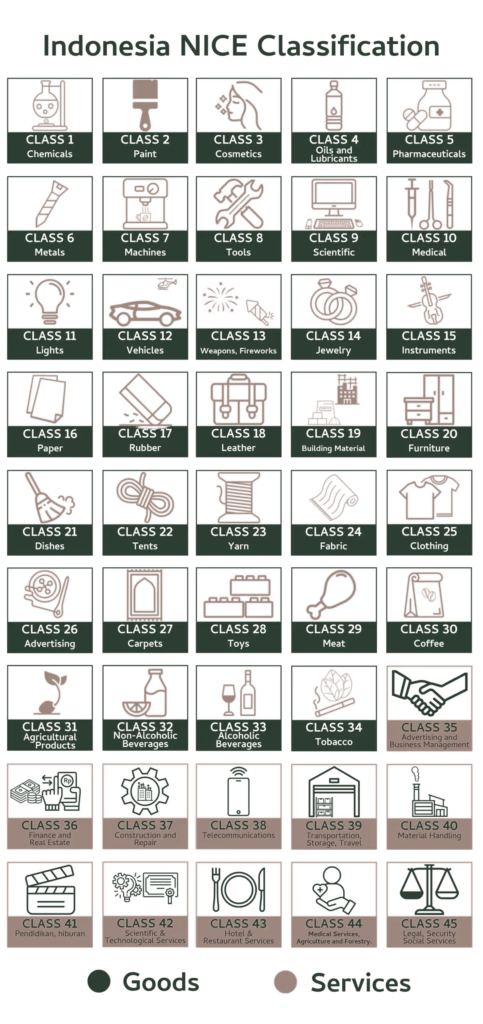
In addition, companies must determine the goods and/or services they intend to protect. There are a total of 45 trademark classifications, consisting of 34 classes of goods and 11 classes of services. Selecting the appropriate classification is essential, as protection must align with the products currently offered or planned to be offered. If a registered trademark covers goods that are not used in the market within three years, the protection for those goods may be subject to cancellation, or the trademark itself may even be revoked.
Trademark Application in Indonesia
A trademark application in Indonesia requires several mandatory documents depending on the applicant’s profile, as follows:
- Applicant’s details such as name and address;
- Trademark details such as the name, logo, and colors;
- List of goods and/or services classifications;
- Identity documents such as ID card or passport;
- Deed of establishment and its latest amendment or other official document stating the company’s name;
- Electronic signature.
Trademark Application Process in Indonesia
Trademark registration in Indonesia does not take as long as in many other countries. The Directorate General of Intellectual Property (DJKI) generally requires around 8 months to complete the registration process, provided that there are no objections from third parties, no refusals based on non-compliance with trademark laws, and no complications arising from multi-class applications. The following is the general process of trademark application in Indonesia:
Formal Examination
Review of the completeness of the required documents and administrative requirements.
Publication
The trademark will be published, allowing any third party who believes they may be affected to file an objection. The applicant is given an opportunity to respond to any objection within a specified period.
Substantive Examination
The trademark will be examined by a trademark examiner. If the application conflicts with any of the trademark characteristics outlined above, it may be proposed for refusal. The applicant may submit a response within the prescribed timeframe. If the trademark complies with the requirements, it will proceed to registration and a certificate will be issued.
Indvesto provides comprehensive trademark services, starting from preliminary analysis to domestic and international trademark registration, with a success rate of 91.3%, as well as handling disputes through litigation or alternative dispute resolution. All processes are carried out by an experienced team supported by registered Intellectual Property Consultants, patent drafters, lawyers, and notaries.