Indonesia has become one of the most attractive foreign investment destinations in Southeast Asia. With a population of more than 270 million people, a growing middle class, and abundant natural resources, the country offers significant opportunities for international companies and investors looking to start a business in Indonesia across various sectors, including manufacturing, technology, infrastructure, and consumer goods.
In recent years, the Indonesian government has introduced a number of regulatory reforms aimed at improving the investment climate and simplifying the process of doing business in the country. These reforms are designed to encourage foreign investment and make it easier for foreign companies to establish and operate their businesses in Indonesia.
However, despite these improvements, foreign investors must still navigate a complex regulatory framework that governs foreign ownership, company establishment, licensing requirements, and ongoing compliance obligations.
This article provides a practical overview of the key legal aspects foreign investors should understand when starting and operating a company in Indonesia, including foreign investment rules, company incorporation procedures, representative offices as an alternative structure, and the process for closing a company.
Foreign Investment Rules in Indonesia
Foreign investment in Indonesia is generally conducted through a foreign-owned limited liability company, commonly known as a PT PMA (Perseroan Terbatas Penanaman Modal Asing). This structure allows foreign individuals or entities to legally establish and operate a business in Indonesia.
A PT PMA is regulated under Indonesia’s investment framework and is subject to specific requirements regarding ownership structure, minimum investment value, and permitted business sectors.
Foreign Ownership Restrictions
Although Indonesia welcomes foreign investment, not all business sectors are fully open to foreign investors. The government regulates foreign participation through a list of business sectors that determines whether a particular industry is:
- fully open to foreign investment
- partially open with foreign ownership limitations
- reserved for domestic investors or subject to specific requirements
Foreign investors must carefully review these restrictions before establishing a company to ensure that their intended business activities are permitted under Indonesian law.
Minimum Investment Requirements
Foreign-owned companies in Indonesia are required to comply with specific minimum investment requirements. As a general rule, a company with foreign investment (PT PMA) must have a total investment value of more than IDR 10,000,000,000 (ten billion Indonesian Rupiah) for each business activity, excluding the value of land and buildings.
In addition, the minimum paid-up capital requirement has been updated under regulations issued in October 2025. Under the current framework, a PT PMA must have at least IDR 2,500,000,000 (two billion five hundred million Indonesian Rupiah) in paid-up capital for each registered business activity classified under the Indonesian Standard Industrial Classification (KBLI), unless specific sectoral regulations provide otherwise.
These requirements are designed to ensure that foreign investment contributes meaningfully to Indonesia’s economic development. In practice, a PT PMA is expected to maintain a substantial investment plan that supports its business operations, including capital allocation for operational activities, asset acquisition, and long-term business development.
Shareholding Structure
A PT PMA may be owned by foreign individuals, foreign legal entities, or a combination of foreign and Indonesian shareholders, depending on the applicable foreign ownership limitations in the relevant sector.
In some industries where foreign ownership is restricted, investors may need to structure their shareholding arrangements in accordance with the permitted foreign ownership percentage.
Understanding the applicable ownership limits is therefore an essential step when planning a foreign investment in Indonesia.
Importance of Regulatory Compliance
Before establishing a PT PMA, foreign investors should conduct a careful legal assessment of their intended business activities, investment structure, and licensing requirements. This helps ensure compliance with Indonesian investment regulations and avoids potential legal or operational issues in the future.
Engaging experienced legal and corporate advisors can also help foreign companies navigate regulatory procedures more efficiently and ensure that their investment structure aligns with Indonesian laws and policies.
Company Incorporation Process in Indonesia
Establishing a foreign-owned company in Indonesia involves several legal and administrative steps. Foreign investors typically establish their presence through a foreign investment company (PT PMA), which allows them to conduct commercial activities in Indonesia.
The incorporation process generally involves preparing corporate documents, obtaining government approvals, and registering the company through Indonesia’s integrated business licensing system.
Understanding each stage of the incorporation process is essential to ensure that the company is legally established and able to operate in compliance with Indonesian regulations.
Determining the Business Activities (KBLI)
One of the first steps in establishing a company in Indonesia is determining the appropriate business classification under the Indonesian Standard Industrial Classification (KBLI) system.
Each company must specify its intended business activities using the relevant KBLI codes. These codes determine several important aspects of the company’s operations, including:
- whether the business sector is open to foreign investment
- applicable foreign ownership limitations
- licensing requirements
- minimum investment obligations
Selecting the correct KBLI classification is therefore a crucial step in structuring a foreign investment in Indonesia.
Preparation of the Deed of Establishment
Once the business activities and shareholding structure have been determined, the founders must prepare a Deed of Establishment before an Indonesian notary.
This document serves as the company’s constitutional document and typically includes important information such as:
- the company name
- business activities
- registered address
- shareholding composition
- capital structure
- management structure, including directors and commissioners
The Deed of Establishment must be prepared in accordance with Indonesian company law requirements.
Approval from the Ministry of Law and Human Rights
After the Deed of Establishment has been signed, the notary will submit the company registration to the Ministry of Law and Human Rights for approval.
Upon approval, the company will obtain legal entity status, which means the company is officially recognized as a legal entity under Indonesian law.
This approval is an essential step in the company formation process, as the company cannot legally operate without obtaining its legal entity status.
Tax Registration and Administrative Requirements
Following the approval of the legal entity status, the company must complete several administrative registrations, including obtaining a Tax Identification Number (NPWP) from the tax authority.
Tax registration allows the company to fulfill its tax obligations and conduct various financial activities, such as opening corporate bank accounts and issuing invoices.
Depending on the nature of the business, the company may also need to complete additional administrative registrations required by relevant authorities.
Business Registration through the OSS System
The next step in the company incorporation process is registering the business through the Online Single Submission (OSS) system managed by the Government of Indonesia. This system serves as the official platform for issuing the Business Identification Number (NIB), which functions as the primary identification of a company, including details of the business activities carried out by the company.
In addition, the OSS system also functions as an administrative platform that helps companies identify the licensing requirements applicable to their business activities. Through this system, companies can determine the types of permits required and proceed with obtaining and completing additional business licenses in accordance with the relevant sectoral regulations.
Representative Office as an Alternative
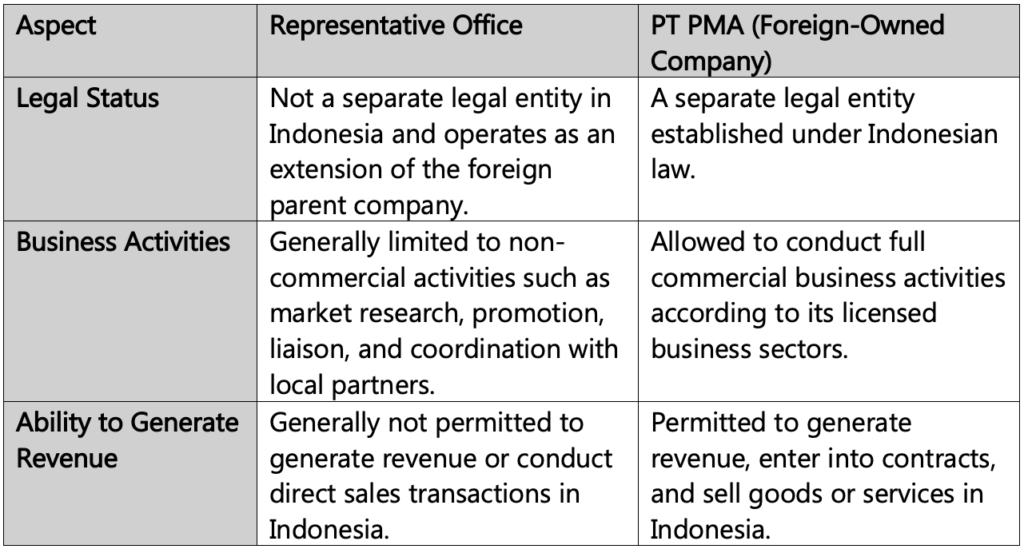
For foreign companies that wish to explore the Indonesian market without immediately establishing a foreign-owned company (PT PMA), setting up a Representative Office can be considered as an alternative option.
A representative office allows foreign companies to establish an official presence in Indonesia while maintaining a relatively simpler operational structure. This option is often used by companies that are still in the early stages of market exploration or those that wish to build business networks before making a larger investment in the country.
Representative Office vs PT PMA in Indonesia
However, it is important for foreign investors to understand that a representative office is fundamentally different from establishing a PT PMA, particularly in terms of legal status and the scope of permitted business activities.
The following table highlights the key differences between a Representative Office and a PT PMA.
Closing a Company in Indonesia
In addition to understanding the process of establishing and operating a business in Indonesia, foreign investors should also be aware of the procedures involved when a company decides to cease its operations. In general, closing a company in Indonesia is carried out through a liquidation process in accordance with applicable laws and regulations.
This process involves several legal and administrative steps that must be completed before the company can be formally dissolved as a legal entity.
Company Liquidation Process
In general, the closure of a company is conducted through a liquidation mechanism aimed at settling all obligations of the company before its legal entity status is formally terminated.
During this process, the company is typically required to complete several key steps, including:
- passing a shareholders’ resolution to dissolve the company;
- appointing a liquidator to manage the liquidation process;
- settling all outstanding obligations to creditors;
- fulfilling the company’s tax obligations; and
- completing the removal of the company’s legal entity status with the relevant authorities.
Each of these steps must be carried out in accordance with the applicable legal procedures to ensure that the company’s closure is conducted lawfully.
Settlement of Legal and Administrative Obligations
Before the liquidation process can be finalized, the company must ensure that all legal and administrative obligations have been properly resolved. This may include the settlement of obligations to employees, tax authorities, and third parties that have legal relationships with the company.
The process may take a considerable amount of time as it often involves coordination with multiple government institutions and administrative verification procedures.
For this reason, companies are encouraged to carefully plan the closure process and ensure that all obligations have been properly addressed before applying for the formal dissolution of the company.
The Importance of Professional Assistance
Given that the process of closing a company in Indonesia involves multiple legal and administrative stages, many companies choose to engage experienced legal or corporate advisors to ensure that all procedures are conducted in compliance with the applicable regulations.
Professional assistance can help companies minimize legal risks, streamline administrative procedures, and ensure that all corporate obligations are properly settled throughout the liquidation process.
For foreign investors seeking reliable guidance on establishing, managing, or closing a business in Indonesia, consulting with Indvesto International Partners can help ensure that every step is carried out with strong legal protection and regulatory compliance. Our team provides transparent advisory services and practical legal solutions designed to support your business objectives while maintaining a cost-efficient approach for international investors operating in Indonesia.
Understanding Indonesia’s corporate regulatory framework is essential for foreign investors planning to enter the Indonesian market. The following frequently asked questions highlight several common issues faced by international businesses when establishing operations in Indonesia.
Frequently Asked Questions (FAQ)
Yes. Foreign investors can establish a company in Indonesia through a foreign investment company (PT PMA). This structure allows foreign individuals or entities to legally conduct commercial business activities in Indonesia, subject to applicable foreign ownership regulations and investment requirements.
In general, a foreign-owned company in Indonesia must have a minimum investment value exceeding IDR 10 billion, excluding land and buildings. In addition, current regulations require at least IDR 2.5 billion in paid-up capital per business classification (KBLI) unless specific sector regulations provide otherwise.
A representative office is generally limited to non-commercial activities, such as market research, promotion, and liaison functions. Companies that intend to conduct full commercial operations typically need to establish a PT PMA.
The timeline for establishing a foreign-owned company in Indonesia may vary depending on the complexity of the business structure and licensing requirements. However, the basic incorporation process, including company registration and obtaining a Business Identification Number (NIB), can usually be completed within several weeks once all required documents are prepared.
For strategic advice on employment structuring, regulatory compliance, or workforce risk management in Indonesia, please reach us at info@indvesto.com. We are ready to assist you with legal strategies designed to support and strengthen your business operations in Indonesia.
info@indvesto.com maulana@indvesto.com (Managing Partners)