A Tourist Visa authorizes a short visit for leisure, family contact, or preliminary business exploration. KITAS, formally an ITAS, or limited stay permit, authorizes a foreign national to reside in Indonesia for a specific, ongoing purpose such as employment, investment, marriage to an Indonesian citizen, study, or retirement. The two exist for different legal reasons, and confusing them is one of the most common, costly mistakes foreign nationals make when planning time in Indonesia.
Overstaying, working on the wrong status, or applying for a permit that doesn’t match the actual purpose of a stay can lead to fines, detention, deportation, or a re-entry ban. Understanding the difference between a Tourist Visa vs KITAS Indonesia before booking a flight or signing a lease saves both money and legal exposure later.
Tourist Visa vs KITAS: What’s the Difference?
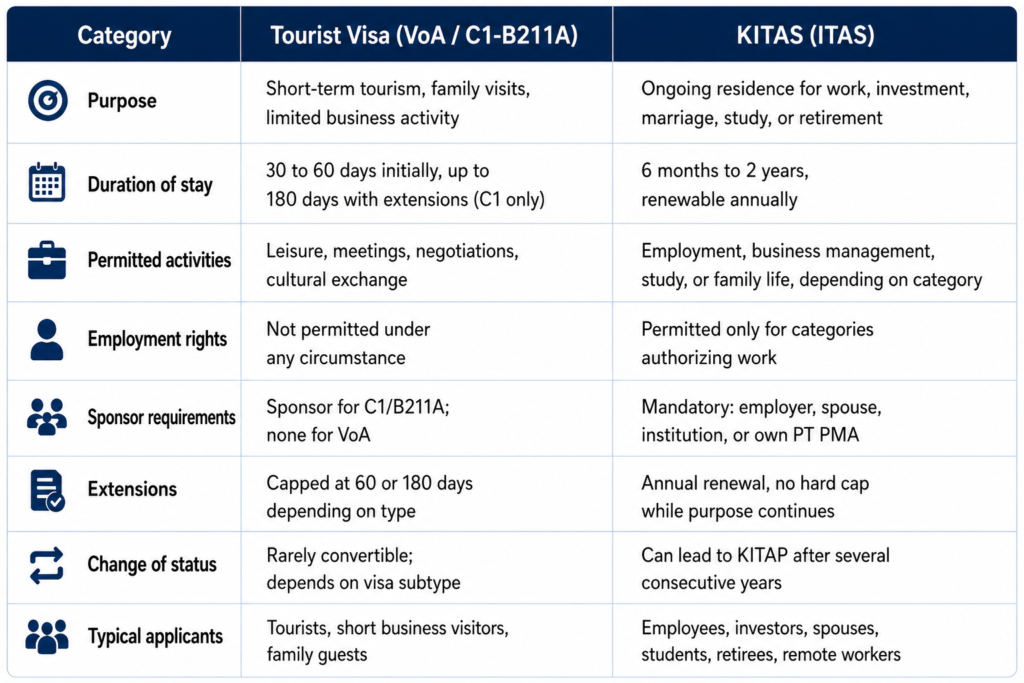
A Tourist Visa is a short-term entry document, good for a few weeks up to roughly six months with extensions, and it creates no ongoing residency status. KITAS is different in kind, not just duration: it establishes a recognized stay permit tied to a sponsor and a defined activity, renewable annually, and it can eventually lead to KITAP, Indonesia’s permanent stay permit.
ITAS and KITAS are used interchangeably in daily conversation but are technically distinct. ITAS (“Izin Tinggal Terbatas”) is the legal status granted by the Directorate General of Immigration. KITAS (“Kartu Izin Tinggal Terbatas”) is the card or electronic document proving that status.
Common Tourist Visa categories include Visa on Arrival (VoA), visa-free entry for a limited set of nationalities, and the C1 visit visa (previously B211A), issued before arrival for tourism, family visits, and business meetings short of paid work. VoA runs 30 days with one extension, to a 60-day maximum. C1/B211A starts at 60 days and can generally be extended twice, reaching 180 days total.
Common KITAS categories are organized by purpose: Work KITAS for employees of an Indonesian company, Investor KITAS for PT PMA shareholders, Spouse KITAS for those married to Indonesian citizens, Student KITAS, Retirement KITAS for applicants 55 and above, Dependent KITAS for family members of a primary holder, and Remote Worker KITAS for employees of foreign companies. Validity generally runs one to two years, renewable, unlike a Tourist Visa, which isn’t meant to be extended indefinitely.
Permitted activities diverge sharply. Tourist Visas cover leisure, cultural exchange, and limited business activity, such as negotiating, signing contracts, and inspecting goods, but never employment or income-generating work, even remote work paid by a foreign employer. KITAS holders may work, invest, study, or reside long-term only within the scope their specific category authorizes. A Spouse KITAS doesn’t by itself grant the right to work; a Student KITAS doesn’t convert to permanent residency regardless of enrollment length.
Which One Is Right for Your Situation?
The right status depends on why someone is coming to Indonesia, not how long the trip feels like it might last.
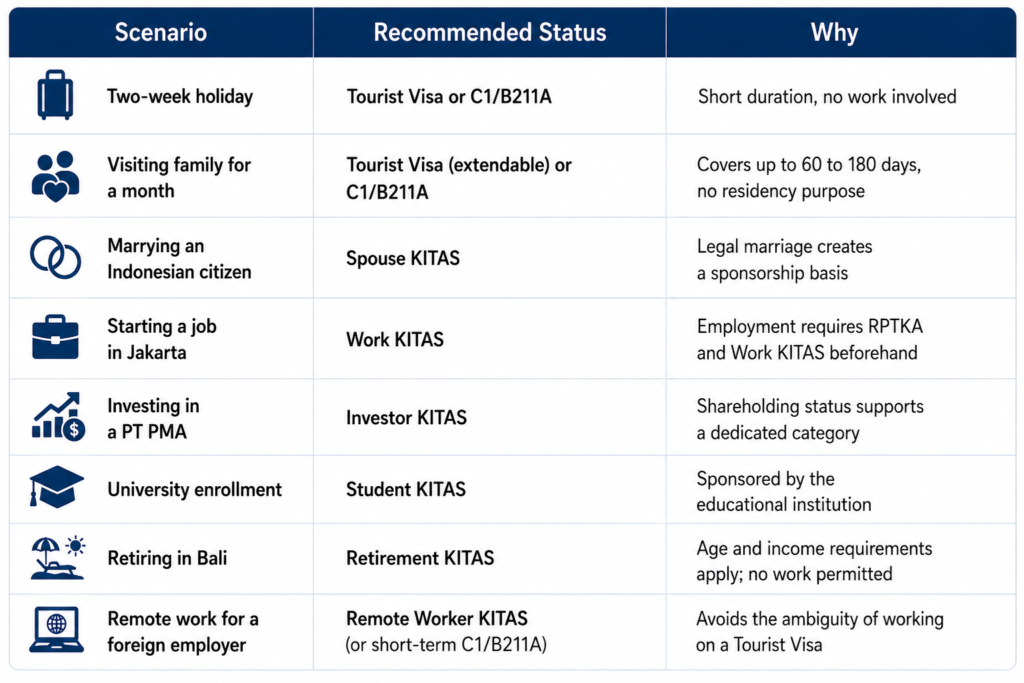
- Holiday or family visit: VoA or C1/B211A covers this cleanly; VoA needs no sponsor, C1/B211A does.
- Marrying an Indonesian citizen: Once the marriage is legally registered, a Spouse KITAS sponsored by the Indonesian spouse is the appropriate route. Entering on a Tourist Visa to marry is common, but a status change is still required afterward.
- Employment: A Work KITAS is mandatory before starting any paid role, alongside RPTKA approval (the government’s foreign manpower utilization plan) processed by the employer. Working while a Tourist Visa is still pending status change is a serious, common violation.
- Investment: Shareholders in a PT PMA typically apply for an Investor KITAS, sponsored by their own company, generally without a separate work permit.
- Studying: International students need a Student KITAS sponsored by the institution. This category does not convert to KITAP regardless of enrollment length.
- Retirement: Applicants 55 and above can apply for a Retirement KITAS, requiring proof of income, health insurance, and a local lease, but no employment is permitted.
- Remote work: Indonesia has no dedicated long-stay tourist product for remote work; using a Tourist Visa while working for a foreign employer sits in a genuine legal gray area under active scrutiny. A Remote Worker KITAS exists for exactly this purpose and is the safer route beyond a short stay.
- Long-term residence: Anyone staying beyond 180 days for any reason needs a KITAS category matching their actual purpose. There’s no general-purpose long-stay tourist option past that point.
Document requirements scale with the category. Tourist Visas need a passport valid six months beyond arrival, proof of onward travel or accommodation, and, for C1/B211A, a sponsor letter. KITAS applications add sponsorship documentation from the employer, spouse, or institution, supporting contracts or marriage certificates, health insurance, and, for work categories, RPTKA or company registration papers. Processing also typically starts with a VITAS, a limited stay visa valid 60 to 90 days, issued before arrival and converted into the actual ITAS once the applicant registers with immigration inside Indonesia.
Cost structures differ meaningfully between the two, but government tariffs and agent fees change periodically and vary by permit subtype and province. Applicants should check current tariffs directly through evisa.imigrasi.go.id or confirm with a licensed immigration consultant rather than budgeting off figures that may already be outdated.
Applying directly for KITAS instead of entering on a Tourist Visa first makes sense whenever the purpose of the stay is already settled: a signed employment contract, completed marriage registration, confirmed enrollment, or an active PT PMA shareholding. Entering on a Tourist Visa “to see how things go” before switching status adds time, cost, and risk without much upside once the purpose is already clear.
Can a Tourist Visa Be Converted into KITAS?
Sometimes, but not automatically, and not from every entry point. Conversion depends on which Tourist Visa category someone holds and what current immigration regulations allow for it.
Visa on Arrival and visa-free entry generally cannot be converted into KITAS. These are single-entry, purpose-limited products; switching status typically requires leaving Indonesia and re-entering under a different visa. C1/B211A offers more flexibility, since it can serve as a bridge toward certain KITAS categories, most commonly Spouse KITAS after marriage and occasionally Investor KITAS, but eligibility depends on the specific rules in force at the time of application, set under Indonesia’s Immigration Law (Law No. 6 of 2011) and its implementing regulations, most recently Permenkumham No. 22 of 2023 as amended by Permenkumham No. 11 of 2024. These rules are revised periodically, so anyone planning a conversion should confirm current eligibility with immigration authorities or a licensed consultant rather than relying on what was true a year or two earlier.
A handful of mistakes account for most immigration trouble. Working while holding a Tourist Visa is the most common and most consequential mistake: no Tourist Visa authorizes paid activity, and enforcement sweeps in tourist-heavy areas have made this easier to catch. Overstaying is nearly as common; daily fines apply from the first day past expiry, escalating to detention and deportation. Choosing the wrong visa category at the outset, such as a business visa for what’s actually employment or a tourist visa for what’s actually relocation, creates delays and sometimes rejection. Assuming every Tourist Visa can eventually become KITAS is another frequent misjudgment; VoA holders in particular are often surprised to learn theirs cannot. Confusing KITAS with KITAP causes its own problems: KITAP is permanent residency, reached only after several consecutive years on KITAS, not a status available directly from a Tourist Visa. Overlooking sponsor requirements rounds out the list: every KITAS category needs a qualified sponsor, and a mismatched sponsor can stall or void an application.
The consequences are concrete. Overstay triggers a daily administrative fine starting immediately, no grace period. Extended overstay, generally past 60 days, can lead to detention, deportation, and a re-entry ban lasting from six months to several years. Working without proper authorization carries similar exposure, including fines against both the individual and any sponsoring company. These penalties follow directly from Indonesia’s Immigration Law and are applied consistently.
Choosing between a Tourist Visa and KITAS comes down to one question: what is the actual purpose of the stay, not how long it lasts. A short trip with no work or residency component almost always belongs on a Tourist Visa. Anything involving employment, investment, marriage, study, or intended long-term residence calls for the matching KITAS category from the outset, even if the visit itself starts small.
Immigration regulations in Indonesia are revised more often than most foreign nationals expect. Anyone uncertain which pathway fits their circumstances, or planning a status change mid-stay, is better served consulting a licensed immigration professional before applying than correcting a mistake after the fact.
Indonesian immigration regulations are updated regularly, including visa classifications, stay permit categories, and administrative procedures. This article reflects the legal framework in force at the time of publication, but individual eligibility and application procedures should always be verified against the latest regulations issued by the Directorate General of Immigration.