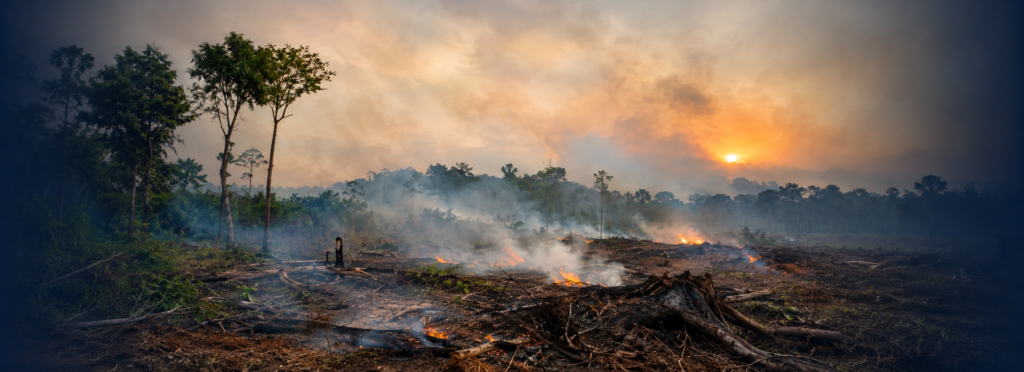
On 29 October 2026, the Ministry of Forestry said its response to forest and land fires no longer stops at suppression and administrative sanctions. It is tracing responsible parties up to beneficial owners and considering compensation claims for forest damage. That puts corporate liability for forest fires in Indonesia in focus, specifically whether responsibility reaches beyond the licence holder to those who instruct, direct, or control the activities.
The Ministry reported the following enforcement position.
- 32 companies have been subject to administrative sanctions, with 12,926.74 hectares of burned area linked to them. Measures include licence freezes and ecosystem recovery orders. Five legal subjects have had their licences revoked.
- Criminal proceedings involve 120 legal subjects. Of these, 39 remain at preliminary inquiry stage and 79 are under formal investigation.
- Twelve individuals and one corporation have been named suspects. Two corporate legal subjects have reached the P-22 stage, involving the handover of suspects and evidence to prosecutors.
These are enforcement stages and not convictions.
Who Faces Corporate Liability for Forest Fires in Indonesia?
Law No. 32 of 2009 on Environmental Protection and Management, as amended, including by Law No. 6 of 2023 (“Environmental Law”), governs liability. Under Article 116(1), where an environmental crime is committed by, for, or on behalf of a business entity, prosecution and sanctions may fall on the entity and/or on the person who gave the order or led the activity. Article 116(2) reaches offences by persons working under an employment or other relationship within the entity’s scope, with sanctions on the order giver or leader, alone or jointly.
Liability depends on whether an individual gave the relevant order or led the activity, not on corporate title. A shareholder or parent company with no such role is not caught by Article 116 through ownership or group control alone. Ownership, control, operational authority, and individual responsibility are separate concepts.
Presidential Regulation No. 13 of 2018 on the Application of the Principle of Recognising Beneficial Owners of Corporations (“Presidential Regulation 13/2018“) serves corporate transparency and the prevention of money laundering and terrorism financing. Identifying a beneficial owner under it does not create liability for a forest fire.
Law No. 1 of 2023 on the Criminal Code, in force since 2 January 2026 and amended by Law No. 1 of 2026 on Criminal Penalty Adjustment, applies the general provisions of Chapters I to V of Book One to offences under other statutes unless otherwise provided (Article 187). Article 47 recognises orderers, controllers, and beneficial owners outside the organisational structure who can control the corporation.
Article 48 establishes grounds for corporate criminal attribution, including whether the offence falls within the corporation’s business or activities under its articles of association or other applicable provisions, unlawfully benefits the corporation, is accepted as corporate policy, results from a failure to take necessary preventive and compliance measures, or is tolerated by the corporation. Article 49, as amended, provides that liability is imposed on the corporation and may also be imposed on functional managers, orderers, controllers, and/or beneficial owners. Beneficial ownership alone does not establish those statutory grounds.
How Corporate Environmental Liability Is Established
Administrative, criminal, and civil liability run on separate tracks. Administrative enforcement turns on a licence holder’s compliance. Criminal liability requires proof of an offence’s elements against an entity or individual. Under Article 87 of the Environmental Law, a person responsible for a business or activity must pay compensation and/or take specified measures where an unlawful act causes pollution or environmental damage resulting in loss to another person or the environment. Article 90 authorises government agencies and regional governments responsible for environmental matters to bring claims for compensation and specific measures.
Article 119 of the Environmental Law permits additional penalties or corrective measures, including confiscation of profits, closure of all or part of the business, remediation, an order to perform unlawfully neglected obligations, and guardianship for up to three years.
Article 56 of Law No. 39 of 2014 on Plantations (“Plantation Law”) prohibits plantation business actors from opening or cultivating land by burning and requires them to have systems, facilities, and infrastructure for controlling land and plantation fires.
A fire within a concession does not by itself establish every element of an offence or any individual’s liability. Proof must link operations, decision making, fault where required, and damage through operational records, fire prevention systems, internal instructions, supervision arrangements, environmental documents, and management decisions.
What Investors and Corporate Groups Should Review
Environmental due diligence for investors in Indonesia should examine both the legal entity and its operations.
- Fire history should be assessed through incidents within and around concessions, subsequent inspections, administrative sanctions, and enforcement proceedings.
- Licence and land right status determines whether the relevant asset may continue operating.
- Fire prevention and control systems, facilities, and infrastructure should be assessed against Article 56 of the Plantation Law.
- Investigations, proceedings, compensation claims, permit status, and environmental monitoring records reveal potential exposure and compliance in practice.
- Ministry of Law Regulation No. 2 of 2025 on Verification and Supervision of Corporate Beneficial Owners requires corporations to designate their beneficial owners and update the relevant information annually. Those records should be compared with actual authority over operational decisions.
Warranties and indemnities should respond to identified recovery and compensation exposure. Corporate liability for forest fires in Indonesia turns on evidence of who acted, instructed, or controlled, and investors should price that risk.