Since 6 July 2026, taxpayers appoint tax representatives under Minister of Finance Regulation Number 44 of 2026 (“PMK 44/2026”). The regulation replaces PMK 229/PMK.03/2014 and redefines who may act for a taxpayer before the Directorate General of Taxes (“DGT”). A company that relies on an adviser to file returns, answer audit requests or work in Coretax needs a test to apply. This article explains the new tax representative rules under PMK 44/2026 and their practical application in Coretax.
What PMK 44 of 2026 Changes for Tax Representatives
A taxpayer appoints a tax representative, known as an attorney-in-fact, through a Special Power of Attorney. PMK 44/2026 recognises three categories.
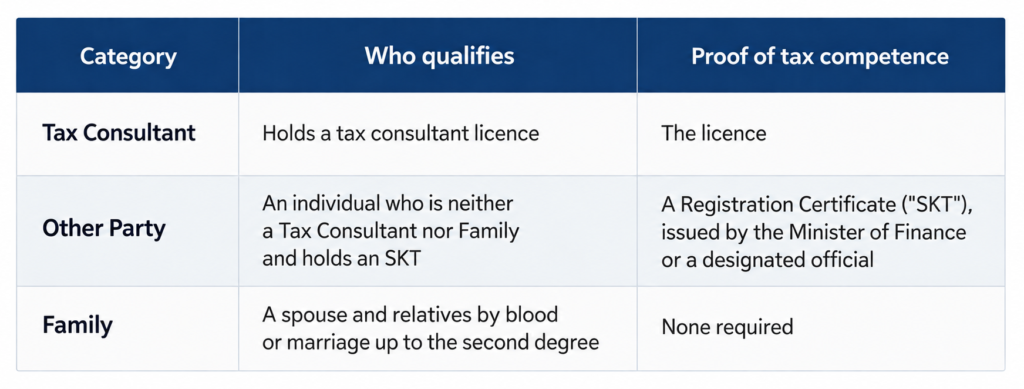
PMK 229/PMK.03/2014 recognised the taxpayer’s employees alongside Tax Consultants. Employees no longer form a category. Except for Family, each representative needs competence in taxation. A taxpayer cannot appoint a person whose licence or SKT is suspended or revoked, and former Ministry of Finance personnel who act as Other Parties face a five year waiting period.
PMK 44/2026 leaves the SKT procedure to PMK 55 of 2026, which gives each SKT a competency classification and a term of three years. Article 9 requires a representative to act within that classification.
Tax Consultants and Other Parties must register in the DGT system by submitting a valid licence or SKT through the Taxpayer Portal or at a tax office. Registration counts as done when an integrated DGT system holds the data. The submission procedure follows the rules for the core tax administration system, Coretax.
A Special Power of Attorney may be electronic, counting as delivered when completed, or on paper, delivered at a tax office. If the document covers electronic filing, the taxpayer must approve the representative’s access to the Taxpayer Portal. Registration of the representative, delivery of the Special Power of Attorney and the taxpayer’s approval of portal access are separate administrative steps.
Each Special Power of Attorney covers one representative and one defined matter, in most cases one tax type for one tax year or period, and the representative cannot pass the authority on. Authority ends on expiry, revocation by the taxpayer, suspension or revocation of the licence or SKT, or conviction of the representative, and portal access ends with it.
In Decision No. 63/PUU-XV/2017, the Constitutional Court held that the statutory delegation to the Minister of Finance over a representative’s rights and obligations is valid if it stays limited to technical and administrative matters and neither restricts nor expands citizens’ rights. The decision addresses the scope of the delegation. It leaves the validity of PMK 44/2026 undecided.
Two transitional rules apply. Article 15 allows a Special Power of Attorney delivered to the DGT before PMK 44/2026 took effect to stay in use according to its contents, so the regulation does not cancel such documents on its effective date. Article 16 adds a second route: until 31 December 2026, a taxpayer may appoint a person who is not a Tax Consultant on the strength of a tax brevet certificate or a tax diploma of at least Diploma III level from an A accredited institution, using a paper Special Power of Attorney. That document stays valid until the delegated matter is completed.
Why Authority and Formal Compliance Matter
A taxpayer remains responsible for the matters it delegates to a representative. Three questions arise, and each depends on different things.
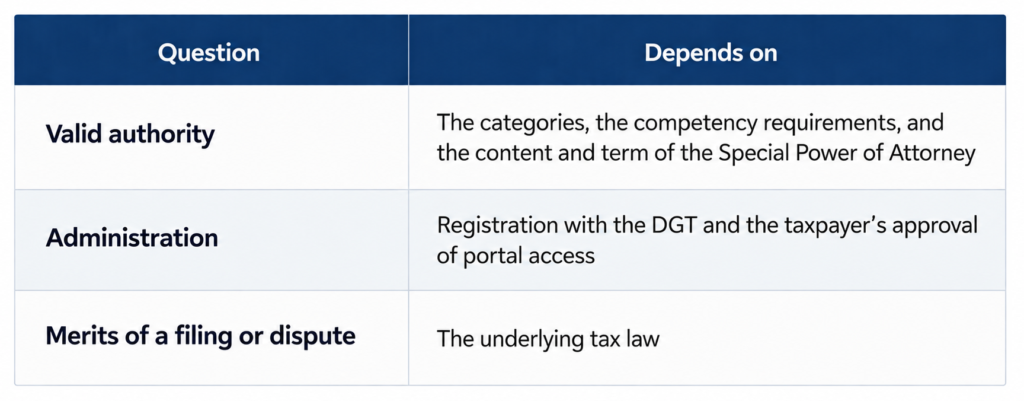
A defect in the first two says nothing about the third.
Example. A company engages an adviser in 2027 for an objection. The adviser holds neither a Tax Consultant licence nor an SKT, so the adviser falls outside the three categories, and the Special Power of Attorney omits objection proceedings. The appointment fails Articles 2(2) and 3, and the adviser cannot act beyond the document. Portal access may not follow. The merits remain undecided, yet the process may stall.
The effect of such a defect on a return, an objection or an appeal depends on the proceeding concerned and the provisions that govern it.
Under PMK 44/2026, companies should review their existing tax representative arrangements before the transitional route closes. Before appointing or retaining a tax representative, companies should check the representative’s:
- Category, licence or SKT status, and classification
- Scope and term of each Special Power of Attorney
- Whether the document reached the DGT before 6 July 2026 or relies on Article 16
- Whether approved portal access matches the authority granted.