We understand that you are reading this because you are exploring or securing business opportunities in Indonesia, one of Southeast Asia’s largest and fastest growing markets.
This guide is designed to provide you with a clear and practical overview of Indonesian employment law by answering the most frequently asked questions from foreign investors and international companies. Our goal is to help you understand the legal framework, employer obligations, and potential risks before hiring employees or starting operations in Indonesia.
How to Hire Foreign Workers (TKA) in Indonesia
Yes, it is permitted.
However, the company must first be established as a legal entity under Indonesian law. In most cases, this means forming a Foreign Investment Company (PT PMA) or another entity type specifically allowed under Indonesian regulations.
A foreign company cannot directly hire employees in Indonesia without a locally registered legal entity.
- RPTKA (Foreign Manpower Utilization Plan)
RPTKA is an official approval issued by the Ministry of Manpower authorizing a company to employ foreign workers.
This document specifies:
The justification for hiring a foreign worker
The position/title
The work location
The duration of employment
Without RPTKA approval, the process cannot proceed.
- DKPTKA (Compensation Fund for the Use of Foreign Workers)
DKPTKA is a mandatory government levy payable by the employer for each foreign worker.
The standard fee is USD 100 per month per foreign worker, categorized as non-tax state revenue (PNBP). Payment of this fee is required before the work authorization is issued.
- Foreign Worker Notification
The Notification is an official document confirming approval of the foreign worker’s employment.
This serves as the legal basis for the foreign national to work in Indonesia and is required to process the limited stay visa and stay permit (e-ITAS / ITAS / KITAS).
- VITAS (Limited Stay Visa)
VITAS is issued to foreign nationals before entering Indonesia.
It allows entry into Indonesia for the purpose of temporary stay, including employment as a foreign worker.
- e-ITAS (Electronic Limited Stay Permit)
e-ITAS is the current electronic form of ITAS (Limited Stay Permit), previously known as KITAS.
This permit allows the foreign national to legally reside and work in Indonesia for a specified period.
Foreign workers may only occupy positions that require specific expertise, competence, or professional experience that is not yet sufficiently available in the Indonesian workforce.
In principle, positions that are not explicitly prohibited are generally allowed, provided they meet regulatory requirements.
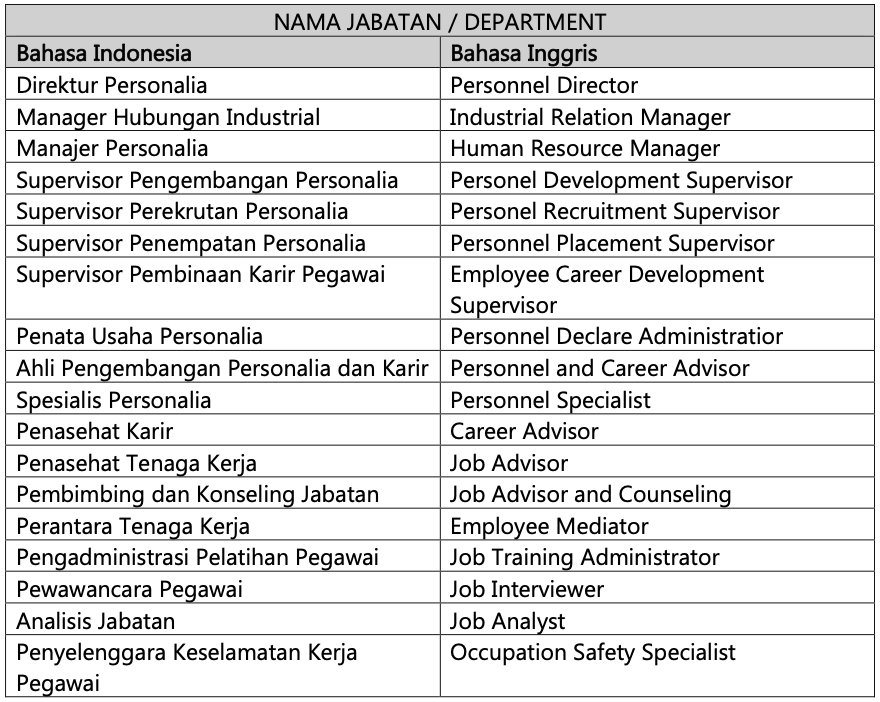
Certain positions, particularly those related to human resources and personnel management, are restricted and cannot be held by foreign nationals.
It depends on their role and level of involvement.
If a Director or Commissioner is actively involved in the company’s daily operational activities in Indonesia, a foreign work permit (RPTKA approval and related documentation) is required.
However, if the Director or Commissioner:
Does not reside in Indonesia; and
Is not involved in daily operational management.
then a work permit is generally not required.
In practice, many companies still choose to secure proper authorization to minimize regulatory risk and avoid potential compliance issues.
Types of Employment Contracts in Indonesia (PKWT and PKWTT)
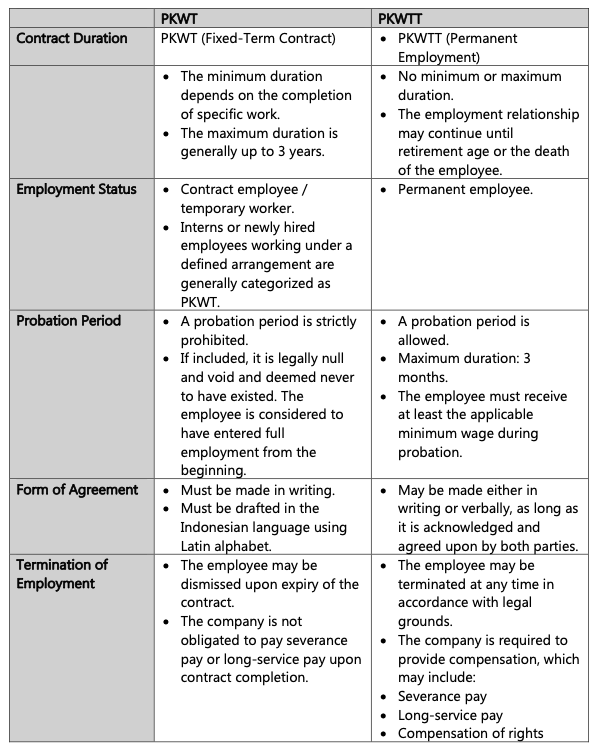
Under Indonesian employment law, there are two main types of employment relationships:
- PKWT (Fixed Term Employment Agreement)
- PKWTT (Indefinite Term Employment Agreement / Permanent Employment)
Understanding the difference between these two contract types is essential for foreign companies hiring employees in Indonesia, as each carries different legal consequences, especially regarding termination and severance.
Minimum Wage in Indonesia
Minimum wage in Indonesia varies by region and, in certain cases, by sector. This system reflects local economic conditions and aims to ensure fair income standards across different provinces and cities.
The minimum wage is determined annually by regional governments based on economic growth, inflation, and employment conditions within their respective areas. Employers are legally required to comply with the applicable provincial or district minimum wage.
The minimum wage applies to employees with less than one year of service in the company. After completing one year of employment, employees may be paid according to the company’s internal wage structure and salary scale, subject to mutual agreement between the employer and the employee.
Working Hours and Overtime in Indonesia
Indonesian employment law recognizes two standard working hour systems:
- 7 hours per day and 40 hours per week (for a 6-day workweek); or
8 hours per day and 40 hours per week (for a 5-day workweek).
Any work performed beyond the normal working hours is considered overtime, and the employer is legally required to pay overtime compensation.
Overtime arrangements must be based on:
The employee’s consent through an employment agreement; or
A written instruction or official order from the company.
Employers are not permitted to replace overtime pay with other forms of compensation unless specifically allowed under applicable regulations.
Common Compliance Mistakes Made by Companies
The most frequent violations related to working hours and overtime include:
Failure to clearly define working hours in the employment agreement;
Failure to pay overtime compensation;
Incorrect calculation of overtime rates.
These issues are among the most common triggers for labor inspections and industrial relations disputes in Indonesia.
Overtime related claims are one of the most frequent employment disputes faced by companies operating in Indonesia, particularly foreign-invested businesses unfamiliar with local labor regulations.
Is It Easy to Terminate an Employee in Indonesia?
Termination of employment in Indonesia cannot be carried out unilaterally without legal grounds. Indonesian labor law is strongly employee-protective, and termination is considered a last resort after other measures have been exhausted.
The employer must provide written notification explaining the reason for termination. If the employee objects, the dispute will be resolved through the industrial relations dispute settlement mechanism.
In practice, termination in Indonesia is legally possible, but it requires valid grounds, proper procedure, and statutory compensation.
Legally Recognized Grounds for Termination
Indonesian law recognizes several lawful grounds for termination, including:
Company merger, consolidation, acquisition, or spin-off, where either the employee or the new management refuses to continue employment.
Company efficiency measures, whether followed by closure or not, due to financial losses.
Company closure due to continuous losses for at least two consecutive years.
Force majeure (extraordinary circumstances beyond control).
Company under suspension of debt payment (PKPU).
Company bankruptcy.
Termination requested by the employee due to employer misconduct, including:
Abuse, gross insult, or threats;
Forcing the employee to commit unlawful acts;
Failure to pay wages for three consecutive months or more;
Failure to fulfill promised obligations;
Assigning work outside the agreed scope;
Assigning work that endangers life, safety, health, or morality not agreed in the contract.
A final decision from the Industrial Relations Court stating the employer did not commit the alleged misconduct, after which the employer proceeds with termination.
Voluntary resignation, provided the employee:
Submits written notice at least 30 days in advance;
Is not bound by a service bond;
Continues working until the resignation date.
Absence for five consecutive working days without valid written explanation, after two proper written summons.
Violation of company regulations or employment agreements after receiving sequential warning letters (first, second, and third warnings).
Employee detention by authorities for at least six months due to alleged criminal conduct.
Long-term illness or work-related disability exceeding 12 months.
Reaching retirement age (generally between 58–65 years).
Death of the employee.
Is Severance Pay Mandatory in Indonesia?
Yes. In most termination cases, the employer is required to pay:
Severance pay
Long-service pay
Compensation of rights
The exact amount depends on the employee’s length of service and the reason for termination.
How Is Severance Pay Calculated?
- Severance Pay
Less than 1 year of service: 1 month salary
1 year or more: 2 months salary (increasing proportionally per additional year of service)
8 years or more: 9 months salary
- Long-Service Pay
3 years or more: 2 months salary
6 years or more: 3 months salary (increasing every 3 years)
24 years or more: 10 months salary
- Compensation of Rights
May Include
Unused annual leave
Repatriation costs for the employee and family to the place of hiring
Housing and medical compensation equal to 15% of severance and/or long-service pay (where applicable)
Other entitlements regulated in the employment agreement, company regulation, or collective labor agreement
Important Note for Foreign Investors
The final termination package depends heavily on:
The reason for termination;
The employee’s length of service;
The structure of the employment contract;
The company’s internal regulations.
Because of this, termination costs in Indonesia can be significant if not planned properly from the beginning of the employment relationship.
Indonesia is not a “hire-and-fire” jurisdiction. Workforce planning, contract structuring, and compliance management are critical to controlling long-term employment risk and termination costs.
Employment law in Indonesia is extensive and goes far beyond termination rules, employment contracts (PKWT vs PKWTT), working hours, or foreign worker requirements. Employers must also comply with broader statutory obligations, including tax compliance, mandatory social security enrollment under BPJS Health and BPJS Employment, preparation of Company Regulations, payment of Religious Holiday Allowance (THR), implementation of Occupational Health and Safety (K3) standards, as well as other administrative and normative obligations under prevailing laws and regulations.
Both local and foreign companies must understand that every employment decision carries legal and financial implications. Managing employees in Indonesia is not merely an operational matter, it is fundamentally a matter of compliance and risk mitigation.
With proper workforce planning, legally sound documentation, and a comprehensive understanding of Indonesian labor regulations, companies can maintain the right balance between protecting employee rights and ensuring long-term business sustainability in a legally secure and commercially efficient manner.