Many people in Indonesia earn a living outside a formal employment relationship with a company. Individuals, families and small groups without a legal entity run businesses where work and pay rest on trust and agreement. Law No. 27 of 2026 on Employment Protection (“Law 27/2026”), promulgated on 28 October 2026, gives these workers a dedicated chapter. Chapter IX, covering Articles 58 to 61, addresses remuneration, disputes and social security. Two questions follow for anyone who engages informal workers. How far does informal worker protection in Indonesia now reach, and what must employers understand about their own obligations?
Who Qualifies for Informal Worker Protection in Indonesia?
Article 1 of Law 27/2026 defines two terms that work together. An informal worker is any person who works in an informal sector business and receives wages, other remuneration or both. The business itself must match a specific description.
An informal sector business under Article 1:
- An economic activity carried out by an individual, a family or a few people working together
- Based on trust and agreement
- Not a legal entity
These definitions sit apart from the definition of an employment relationship. Article 1 describes that relationship as one between an employer and a worker under an employment agreement, with the elements of work, wages and orders. Law 27/2026 places informal workers in their own chapter and attaches specific duties to the employer. Employers should not assume that every rule built for formal employment applies to informal work in the same way. Certain work relationships based on partnership agreements, including work through digital platforms, are regulated separately under Article 102.
Informal status does not strip a worker of legal protection. The law names these workers and gives them rights that employers must respect.
Fair Remuneration and Social Security Rights
Article 58 requires an employer of informal workers to pay wages or other remuneration that is fair and reasonable for the work performed. The law lists three considerations.
What Article 58 weighs:
- Working time
- Risk of the work
- Operating costs the worker bears
Each factor changes what a fair payment looks like. When a worker supplies tools, transport or materials, a payment that looks adequate on paper can leave little after costs. Because the law lists risk as a factor, the danger of the work enters the pricing discussion instead of falling on the worker alone. Working time shows how much of the worker’s day the arrangement takes. The three factors tie payment to the actual conditions of the job.
Article 60 gives every informal worker the right to social security, applied under existing laws and regulations. Article 61 adds support for workers in the vulnerable category. They are entitled to social security through contribution assistance, which the central government, regional governments or both provide. The cover includes at least work accident insurance and death insurance.
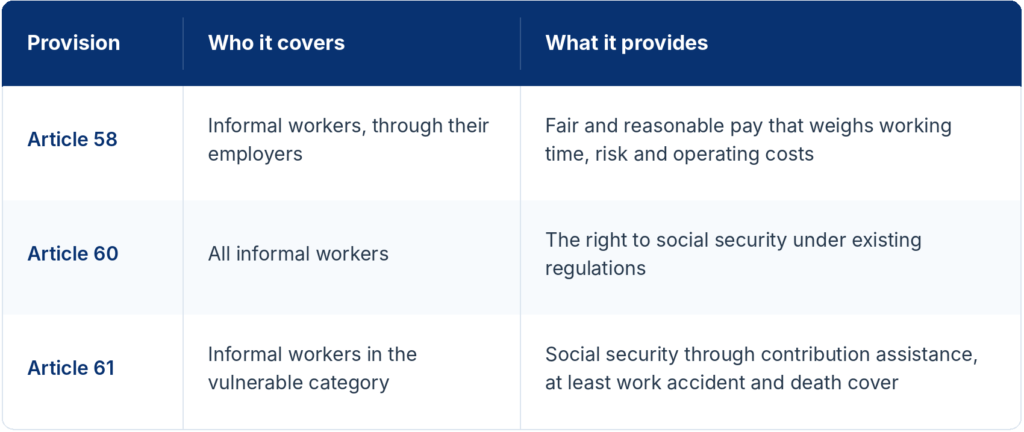
Contribution assistance does not apply automatically to every informal worker. It targets the vulnerable category, which Article 61 does not define. Article 61(4) leaves further rules on the assistance to a Government Regulation. The protections address payment, the risks of the work and the worker’s continued welfare.
Resolving Disputes and Understanding Employer Obligations
Article 59 sets the route for disagreements. A dispute over the agreement between an informal worker and an employer goes first to deliberation aimed at consensus. If the parties do not reach agreement, they may take the dispute to the district court.
Because disputes concern the agreement, the agreement carries the weight. A written record gives both parties something to rely on. Employers should record the points below.
Terms to document:
- The work to be done
- The payment and how it is made
- Working time
- The responsibilities of each party
- Operating costs the worker bears
Employers owe fair and reasonable remuneration under Article 58. Social security is a right of the worker under Articles 60 and 61, and Article 61 places contribution assistance for vulnerable workers with the government. Small business owners and family businesses should read these duties alongside the arrangements they have with informal workers. The practical details will come from the Government Regulation that Article 61(4) requires. A right in the statute helps only when employers and workers understand how it is applied and enforced.
Law 27/2026 extends legal recognition to informal workers and gives employers and government clearer responsibilities. Informal worker protection in Indonesia now has a statutory footing that employers should plan around.