Minister of Manpower Regulation No. 7 of 2026 on Outsourced Work (“Permenaker 7/2026”), took effect on 30 April 2026, the day the Minister signed it. Companies operating in Indonesia have until 30 April 2028 to bring the type and scope of their outsourcing arrangements into line.
The regulation narrows lawful outsourcing to six categories of supporting work. It applies to arrangements structured as provision of workers, not to outsourcing of work in general. It sets mandatory content for outsourcing agreements, splits responsibility for worker protections between the provider and the user company, and gives companies a two-year window to adjust the type and scope of outsourced work. Existing contracts otherwise stay valid until they expire.
For a business already using an outsourcing provider in Indonesia, the operative question is whether the current arrangement still falls within the permitted scope.
What Changed
Permenaker 7/2026 replaces the open discretion companies used to exercise over which functions to outsource with a closed list of six permitted categories, and confines the regulated arrangement to the provision-of-workers model. It applies to every company operating in Indonesia that engages a third-party outsourcing provider to supply workers for supporting activities.
The regulation implements Article 64(2) of Law No. 6/2023 and follows Constitutional Court Decision No. 168/PUU-XXI/2023. It sits alongside Government Regulation 35/2021 (GR 35/2021), which stays fully in force. GR 35/2021 already requires the relationship between an outsourcing provider and the workers it employs to rest on a fixed-term (“PKWT”) or open-ended (“PKWTT”) employment contract, and requires the provider to be a licensed legal entity. Permenaker 7/2026 adds a new layer on top, covering which categories of work companies may outsource, what the business-to-business outsourcing agreement must contain, and new registration and sanction mechanics. Two distinct agreements now sit side by side, and the difference matters.
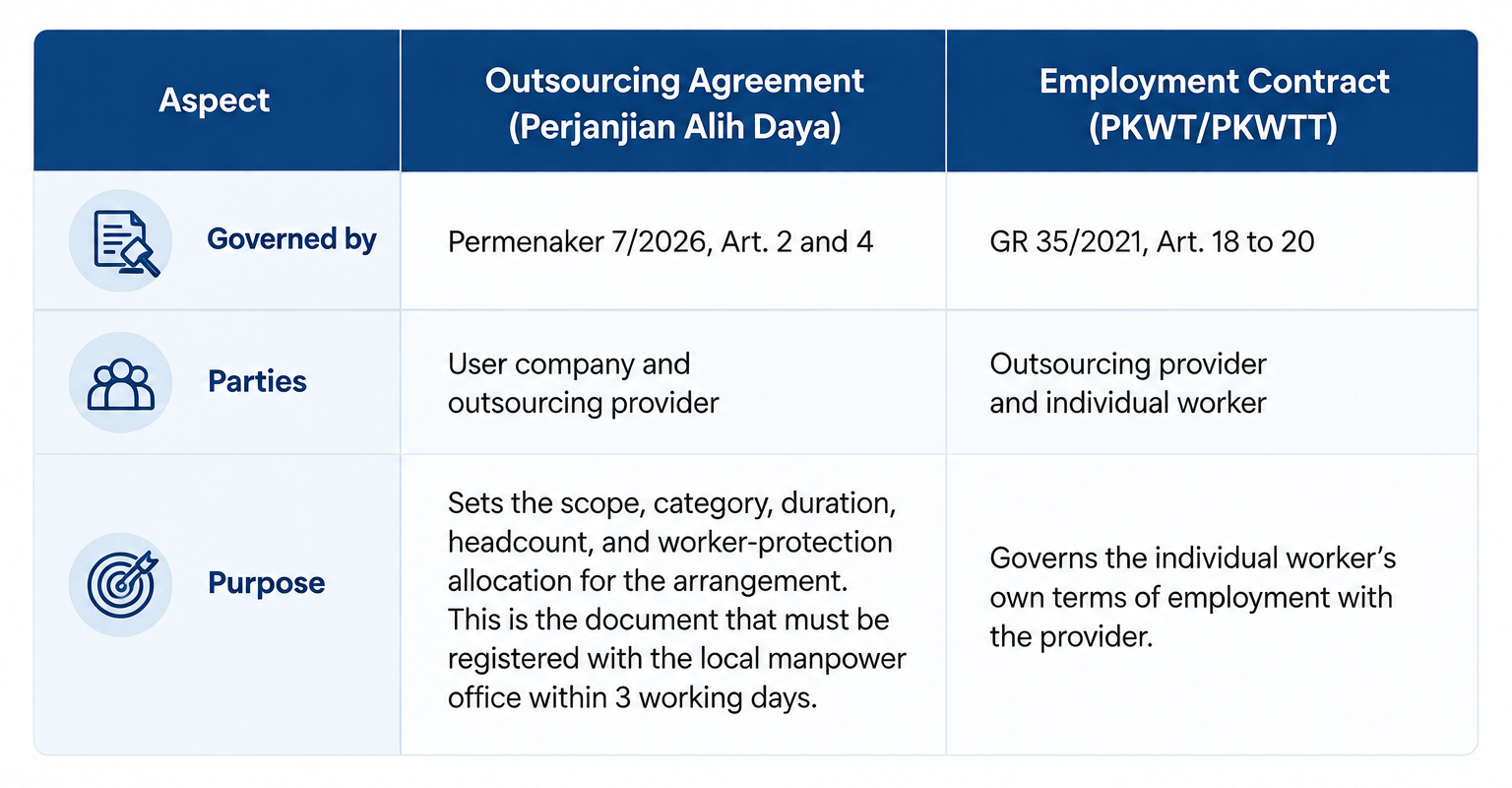
Confusing the two creates a common compliance trap. The 3-day registration duty applies to the outsourcing agreement between the two companies, not to each worker’s individual employment contract.
Permitted Categories and Sanctions for User Companies
Under Article 3, a company may only hand off part of its work to an outsourcing provider through a provision-of-workers arrangement, and only when that work falls into one of six permitted categories.
Six Permitted Outsourcing Categories
Cleaning services
Food and beverage provision
Security services
Provision of drivers and worker transportation
Operational support services
Supporting work in mining, oil, gas, and electricity
A company outsourcing a function outside this list runs into a structural compliance problem, not a paperwork gap. Article 8 exposes the user company itself, not just its provider, to administrative sanctions for outsourcing outside these categories. The Ministry issues a written warning first, then moves to staged business restrictions such as limits on production capacity or delayed business licensing at other project locations.
Agreement Requirements and Provider Obligations
Article 4 sets a mandatory minimum content for every outsourcing agreement. The agreement must state the scope of work being outsourced, the duration of the agreement, the location where the work happens, the headcount of outsourced workers involved, the worker protections built in, and how rights and obligations split between provider and user company.
Every agreement must build in these minimum worker protections.
- Wages and overtime pay
- Working hours and rest periods
- Annual leave
- Occupational health and safety
- Social security
- Religious holiday allowance (THR)
- Rights on termination of employment
The outsourcing provider carries responsibility for fulfilling these protections, at least to statutory minimums. The user company carries a supervisory duty to confirm the provider fulfills them. That duty does not substitute for the provider’s own liability.
As a licensed outsourcing business operator, the provider must apply occupational safety and environmental standards, register the outsourcing agreement with the district or local manpower office where the work happens within 3 working days of signing, and start business activities within 1 year of receiving its business license.
If the local manpower office finds the agreement falls short of the Article 3 or Article 4 requirements, it can withhold the registration certificate. That gives regulators a checkpoint to catch non-compliant scope before a dispute arises. If the outsourcing provider fails its licensing obligations under Article 6, it faces sanctions under the risk-based business licensing regime, which sets no separate sanction schedule in this regulation.
Timeline for Existing Arrangements
Existing agreements remain valid until their own term expires. The type and field of outsourced work must align with the permitted categories no later than 30 April 2028, two years after promulgation.
That two-year clock applies to the type and field of outsourced work specifically. It does not force every existing contract into renegotiation or termination by that date if the scope already fits one of the six categories.
Action Checklist
Review each outsourcing arrangement against the applicable legal requirements and take corrective action where necessary.
Map every current outsourcing arrangement against the six permitted categories.
Confirm each arrangement is structured as provision-of-workers, not a disguised work-contracting scheme.
Check agreements contain all six mandatory elements under Article 4.
Confirm the provider registered the agreement with the local manpower office within 3 working days of signing.
Verify the provider started operations within 1 year of licensing.
Flag any arrangement outside the permitted categories and prepare a structural alternative before 30 April 2028.