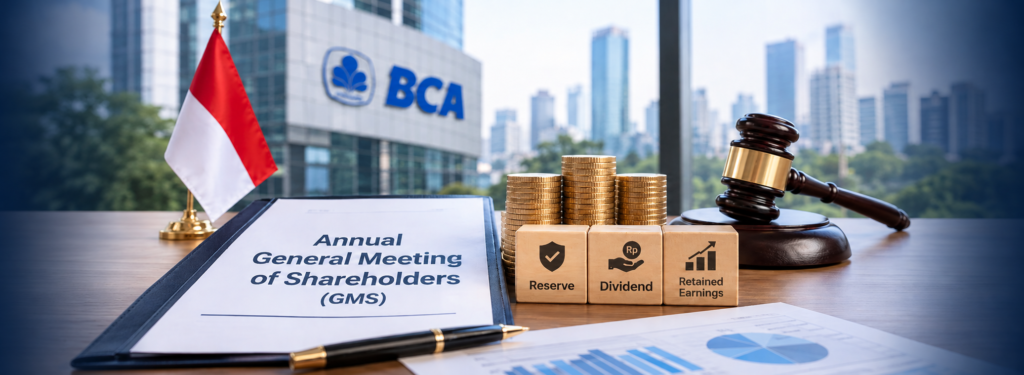
On 19 November 2026, PT Bank Central Asia Tbk (“BCA”) announced the last interim dividend for financial year 2026, set at Rp35 per share. Total interim dividends for the year reach Rp80 per share. BCA also confirmed that these payments will be counted toward the final dividend, which still needs shareholder approval at the 2027 Annual General Meeting of Shareholders (“GMS”). Interim payments do not replace the Annual GMS. How does a company decide what to do with its profit, and where does the law set limits?
What the Annual GMS Decides About Net Profits
Law No. 40 of 2007 on Limited Liability Companies, as amended (“Company Law”), requires an Annual GMS within six months after the financial year ends under Article 78. The meeting does more than receive reports. Under Articles 66 and 69, directors present the annual report, and shareholders approve it and ratify the financial statements. The profit decision follows from those approvals.
Article 71(1) gives the GMS the power to decide how net profit is used, including how much is set aside as a reserve under Article 70. For the annual allocation, that choice belongs to the shareholders in the meeting, not to the board.
Article 71(2) sets a default rule. All net profit remaining after the reserve is distributed as dividends, unless the GMS decides otherwise. A GMS may therefore keep profit in the company to fund expansion.
Making a profit is also different from being able to pay a dividend. Article 71(3) allows dividends only when the company has positive retained earnings. According to the Elucidation, current year profit must first cover losses carried over from earlier years. A profitable year can still leave nothing to distribute.
Legal Limits on Reserves and Dividend Payments
Article 70 requires a company to set aside part of its net profit each year as a reserve, but only while it has positive retained earnings. This continues until the reserve reaches at least 20% of issued and paid up capital. That figure is a minimum target for the reserve balance. It does not require the company to set aside 20% of its profit every year. Until the target is met, Article 70(4) allows the reserve to be used only to cover losses that other reserves cannot absorb.
Final and interim dividends follow different rules.
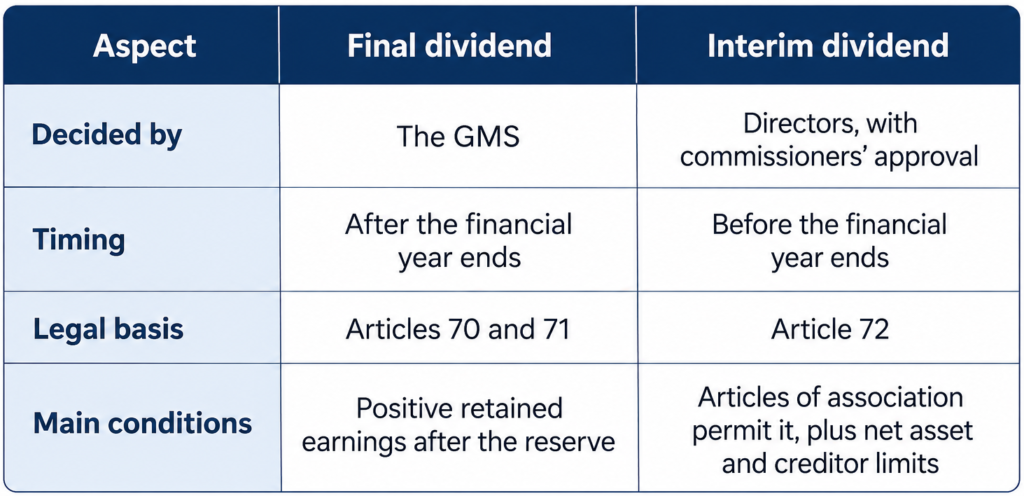
For an interim dividend, Article 72 requires that the articles of association allow it. Net assets must not fall below issued and paid up capital plus the mandatory reserve. The payment must also not prevent the company from meeting its obligations to creditors or disrupt its business. BCA’s announcement followed this structure, since the dividend was decided by directors with commissioner approval.
Risk remains until the year closes. If the company ends the year with a loss, shareholders must return the interim dividends they received under Article 72(5). If they cannot, directors and commissioners become jointly and severally liable for the company’s loss under Article 72(6).
Dividends can go unclaimed. Under Article 73, dividends not collected five years after the payment date go into a special reserve. If they remain unclaimed for another ten years, they become the company’s right.
What Companies and Shareholders Should Consider
Before proposing an allocation, directors should weigh liquidity, planned expansion, capital expenditure and obligations to creditors against the return shareholders expect. According to the Elucidation to Article 71(1), the GMS decision should consider the company’s interests and fairness.
Shareholders should review the proposal before the meeting. They should see how much goes to reserves, how much is paid as dividends and how much stays as retained earnings. Where interim dividends were paid, they should check how those amounts are counted in the final dividend, as BCA described for 2026. For listed companies, Indonesia Stock Exchange rules require the announcement of an interim dividend distribution, including its schedule, no later than two Trading Days after the Board of Commissioners approves the Board of Directors’ decision to distribute the interim dividend. Shareholders who cannot attend in person can read about electronic GMS participation.
The resolution should be precise. It should state which amount is an interim dividend, which is a final dividend and which is retained. It should also match the financial statements ratified at the meeting, the articles of association and the actual payment. Companies should record these decisions properly, and our guide to GMS resolutions and meeting records explains how.
The Annual GMS is where a company decides how its profit will be used. A dividend is more than a return to shareholders. It must respect statutory reserves, retained earnings and the company’s ability to meet its obligations. INDVESTO advises directors, commissioners and shareholders on corporate governance and GMS resolutions. Contact our team to review your dividend proposal before it reaches the meeting.